Gold steadies near $3,350 as weak US NFP data boosts Fed rate cut bets

- Gold surges to $3,350 following a weaker-than-expected July NFP report.
- The US economy adds 73K jobs, missing the consensus of 110K.
- US President Donald Trump’s sweeping tariff executive order renews trade tensions, limiting Gold’s downside.
Gold (XAU/USD) surges to $3,350 on Friday after a weaker-than-expected US Nonfarm Payrolls (NFP) report triggered a broad US Dollar sell-off and revived expectations of a September interest rate cut by the Federal Reserve (Fed). The yellow metal was trading flat near $3,300 during European trading hours, pressured by a firm US Dollar and the Fed's data-dependent hawkish stance.
However, the disappointing July NFP print triggered a sharp repricing in rate expectations, with markets now pricing in an 82% probability of a rate cut at the Federal Reserve’s September meeting, a sharp jump from just 37% prior to the NFP release. The dovish shift fueled a strong rally in Gold, which surged nearly 2.0% during the American trading session, briefly approaching the $3,350 psychological level, but stopped short of a clear breakout as traders weighed fresh Fed commentary.
Fed officials maintained a cautious tone despite the market’s aggressive repricing of rate cut expectations. Fed’s Hammack acknowledged that monetary policy remains “a little bit restrictive” but “not far from neutral,” adding that “a lot more data” will be assessed ahead of the September FOMC meeting. Meanwhile, Fed’s Bostic reiterated his base case for one rate cut this year, though he signaled openness to adjustments, stating he is “open to changing his view if the data supports it.” He further commented that “today’s numbers raise the salience of the risks to employment,” but cautioned that “the risk to inflation is much greater than the risk to employment.”
Market movers: Markets eye NFP after Trump's tariff shock and solid US data
- July's NFP report showed the US economy added just 73,000 jobs in July, far below the market consensus of over 100,000 and marking the smallest monthly gain this year, while previous months’ job gains were revised sharply lower by a combined 258,000, further dampening sentiment toward the US Dollar. The Unemployment Rate ticked up to 4.2% in July from 4.1% in June, aligning with market expectations. The modest rise reflects easing labor market conditions and reinforces the overall dovish tone of the July jobs report.
- Wage growth held steady in July, offering a mixed signal on underlying inflation pressures. Average Hourly Earnings rose 0.3% MoM, in line with expectations and up from the 0.2% gain in June. On a yearly basis, wages increased 3.9% YoY, slightly above forecasts of 3.8% and unchanged from the prior reading.
- In the manufacturing sector, the S&P Global Manufacturing Purchasing Managers Index (PMI) rose slightly to 49.8 in July, beating expectations of 49.7 and improving from 49.5 previously. However, the more closely watched ISM Manufacturing PMI fell short of forecasts, dropping to 48.0 from 49.0 and signaling ongoing contraction in factory activity.
- US consumer sentiment also softened in July, adding to the cautious economic tone. The Michigan Consumer Sentiment Index slipped to 61.7, slightly below the expected 62.0 and down from 61.8 previously. Meanwhile, the Consumer Expectations Index declined to 57.7, missing the 58.6 forecast.
- On Thursday, US President Donald Trump signed a sweeping executive order imposing new reciprocal tariffs ranging from 10% to 41% on imports from nearly 70 countries. Among the hardest hit countries are India, Canada, Switzerland, Taiwan and Brazil. The move escalates global trade tensions and threatens to disrupt supply chains at a time when inflation concerns are reemerging. While the initial deadline was set for August 1, the executive order states that the new tariffs will generally take effect from August 7.
- The Trump administration has introduced a universal 10% tariff on imports from countries where it runs a trade surplus, and a 15% minimum rate for roughly 40 nations with which it holds a trade deficit.
- Tariff uncertainty lingers for two of the US key trading partners as China and Mexico are still locked in unresolved negotiations. China’s temporary tariff relief is set to expire on August 12, after which duties could rise to 15% or more if no agreement is reached. Meanwhile, Mexico has secured a 90-day extension, maintaining its current tariff regime for now but leaving the door open to steeper hikes later this year.
- The yield on the 10-year US Treasury slipped to around 4.24%, while the 30-year yield eased to 4.81% on Friday, with both benchmarks hovering near one-month lows. The drop in yields reflects a cautious shift in investor sentiment following the softer-than-expected July Nonfarm Payrolls report. Lower yields reduce the opportunity cost of holding non-yielding assets like Gold, fueling a sharp rebound in XAU/USD after a week of bearish price action.
- The US economy grew at a 3.0% annualized rate in the second quarter, marking a strong rebound from the prior quarter’s contraction. Core Personal Consumption Expenditure (PCE) inflation, the Fed’s preferred measure, held steady at 2.8% YoY in June, slightly above expectations of 2.7. Meanwhile, private payrolls rose by 104,000 in July, recovering from a decline in the previous month and signaling continued strength in the labor market.
- Markets reacted swiftly, according to the CME Fedwatch tool, the probability of a September interest rate cut by the Fed fell to around 39%, down sharply from 65%. Meanwhile, odds for a 25 basis point cut in October stand near 47% as persistent inflation reinforces the central bank’s “wait-and-see” approach.
Technical analysis: XAU/USD recovers sharply as NFP disappoints
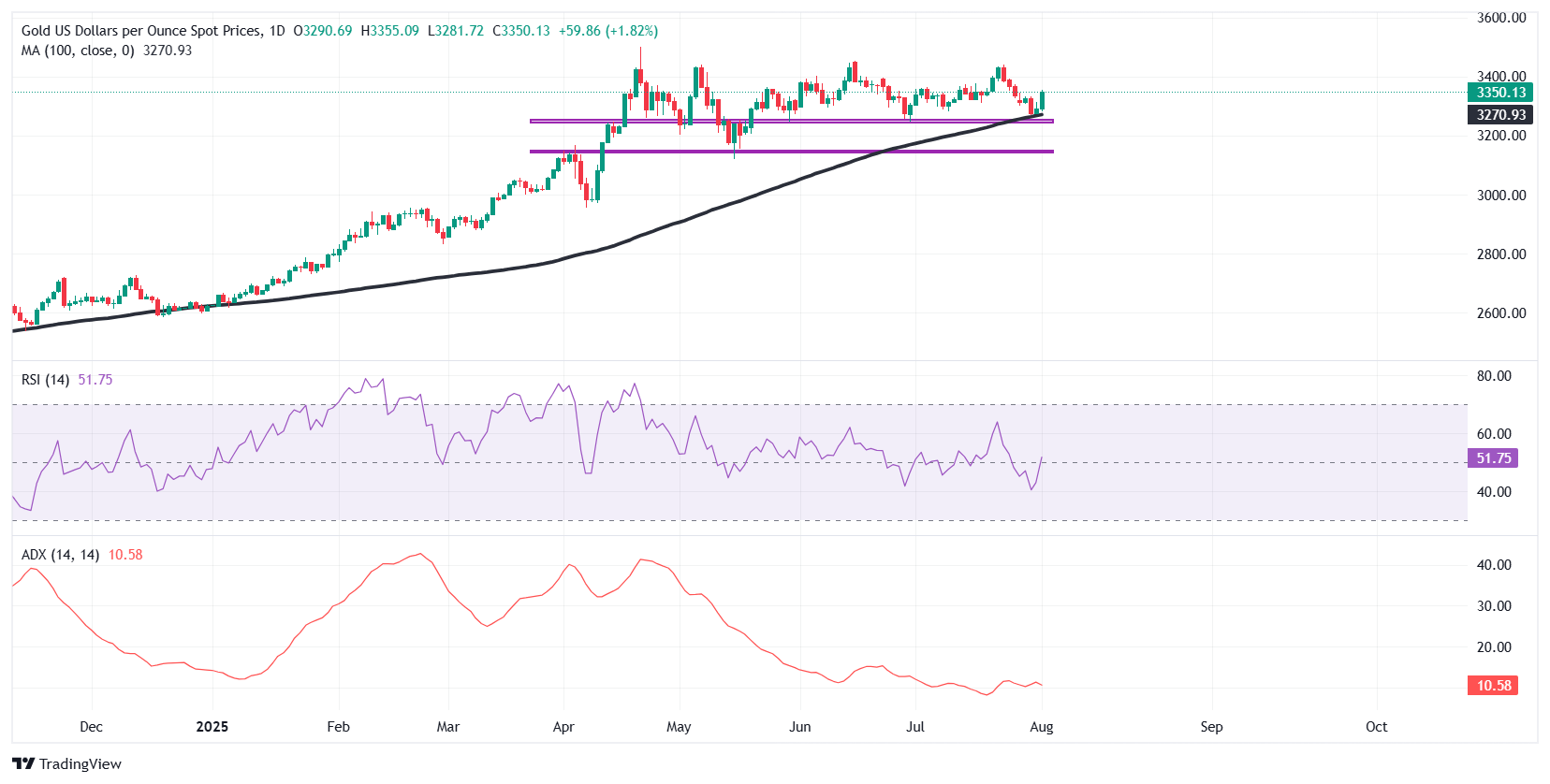
On the daily chart, XAU/USD recovers above the $3,300 mark, rebounding from a one-month low hit earlier this week. Following Wednesday’s dip, the price has been consolidating in a relatively narrow range, but Friday’s post-NFP surge injected fresh bullish momentum. However, despite the strong intraday bounce, price action still lacks a decisive breakout, with the $3,350 region acting as immediate resistance. A sustained move above this zone is needed to confirm a bullish reversal.
The $3,270-$3,250 zone marks the first key support, aligned with the 100-day Exponential Moving Average (EMA) and a prior demand area. A decisive break below this level could open the door toward deeper support near $3,150.
Momentum indicators paint a cautious picture. The Relative Strength Index (RSI) sits at 51, reflecting weakening bearish sentiment while pointing above the neutral line. The Average Directional Index (ADX) remains extremely low at 11.76, indicating a lack of trend strength and overall market indecision.
Gold FAQs
Gold has played a key role in human’s history as it has been widely used as a store of value and medium of exchange. Currently, apart from its shine and usage for jewelry, the precious metal is widely seen as a safe-haven asset, meaning that it is considered a good investment during turbulent times. Gold is also widely seen as a hedge against inflation and against depreciating currencies as it doesn’t rely on any specific issuer or government.
Central banks are the biggest Gold holders. In their aim to support their currencies in turbulent times, central banks tend to diversify their reserves and buy Gold to improve the perceived strength of the economy and the currency. High Gold reserves can be a source of trust for a country’s solvency. Central banks added 1,136 tonnes of Gold worth around $70 billion to their reserves in 2022, according to data from the World Gold Council. This is the highest yearly purchase since records began. Central banks from emerging economies such as China, India and Turkey are quickly increasing their Gold reserves.
Gold has an inverse correlation with the US Dollar and US Treasuries, which are both major reserve and safe-haven assets. When the Dollar depreciates, Gold tends to rise, enabling investors and central banks to diversify their assets in turbulent times. Gold is also inversely correlated with risk assets. A rally in the stock market tends to weaken Gold price, while sell-offs in riskier markets tend to favor the precious metal.
The price can move due to a wide range of factors. Geopolitical instability or fears of a deep recession can quickly make Gold price escalate due to its safe-haven status. As a yield-less asset, Gold tends to rise with lower interest rates, while higher cost of money usually weighs down on the yellow metal. Still, most moves depend on how the US Dollar (USD) behaves as the asset is priced in dollars (XAU/USD). A strong Dollar tends to keep the price of Gold controlled, whereas a weaker Dollar is likely to push Gold prices up.

 Copy Link
 Share on Facebook
 Share on X
 Share by Email