Why Operational Blind Spots Now Cost Brokers More Than Market Volatility

2025 became a year when the brokerage industry stopped talking in abstractions and started speaking plainly — not on panels, but in private meetings, technical workshops, and late-evening conversations at exhibitions.
Our team spent the year moving between Hong Kong, Dubai, Limassol and London, meeting with more than 200 brokers of every size and model.
We also reviewed thousands of operational alerts and incidents across dozens of trading servers.
What emerged from these conversations and data points is a consistent, industry-wide pattern:
The primary pressure on brokers is no longer market volatility or toxic flow — it is operational complexity.
And this trend will define 2026 far more than any single regulatory update.
Why these insights matter — and why brokers are openly discussing them now
Several global regulators, including ESMA, have highlighted a rise in operational and technology risks across financial firms, noting that disruptions, cyber incidents and system failures are now among key threats to market stability.
What brokers privately shared with us throughout 2025 reflects exactly this global direction — but in a far more practical, day-to-day way.
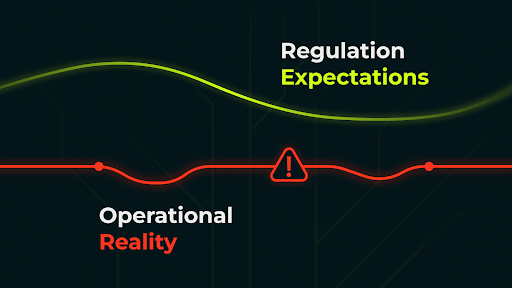
And that gap between regulatory expectation and operational reality is where the true transformation is happening.
1. Operational risk quietly became more painful than market risk
Across regions, business models and platforms, brokers told us variations of the same theme:
“Our most expensive surprises last year didn’t come from clients or volatility — they came from internal problems.”
These were not rare anomalies. We repeatedly saw issues such as:
incorrect margin or leverage profiles applied after updates,
swaps drifting on multiple symbols without detection,
liquidity streams going offline unnoticed,
hedging rules not triggering on new groups,
pricing inconsistencies between servers,
legacy routing rules conflicting with new execution logic.
Regulators describe this in broad terms as “operational resilience.”
Brokers describe it much more simply:
“We just didn’t see it in time.”
This is the defining vulnerability of the modern brokerage stack.
2. Toxic flow evolved — not only in speed, but in adaptability
Finance Magnates has long covered latency arbitrage and toxic flow, but what brokers described in 2025 shows a new generation of behaviour:
mobile-first micro-scalping using real-time volatility triggers,
cross-venue timing strategies that appear only during thin liquidity,
adaptive bots whose patterns shift intra-day,
“pulse” activity that spikes when hedging latency is highest,
hybrid models blending social trading with automated decision engines.
One broker in Hong Kong summarised it well:
“The problem isn’t speed anymore. It’s that the patterns learn faster than we can classify them.”
This aligns with the broader market trend:
Toxic flow is no longer a static signature — it is a moving target.
3. Compliance shifted from documentation to real-time evidence
In 2025, regulatory priorities across Europe, MENA and APAC converged around similar themes:
demonstrable operational resilience,
clear audit trails for execution and routing,
transparency in pricing and internal risk handling,
real-time monitoring of anomalies and abusive patterns,
readiness for system failures and data-quality issues.
Several brokers we spoke with noted that recent regulatory reviews focused less on what policies say
and far more on whether the broker can prove operational control in real time.
This is a significant change.
Compliance is becoming a data consistency challenge, not a paperwork exercise.
4. Multi-server, multi-asset expansion created exponential operational complexity
A typical mid-size broker in 2025 operated:
multiple MT4/MT5/cTrader/Match-Trader servers,
dozens of symbol groups, corporate actions and swap profiles,
multi-jurisdiction liquidity streams,
hybrid execution models,
thousands of instruments including crypto, stocks, indices and commodities.
Each new LP, new asset class, or new server adds an entire layer of operational risk.
Across dozens of audits and technical reviews, we saw the same pattern:
Brokers are scaling faster than their internal visibility.
The result is simple but dangerous:
blind spots appear exactly where complexity grows fastest.
5. Brokers who avoided major incidents in 2025 had one thing in common: clarity
It wasn’t the biggest teams or the most aggressive risk models.
It wasn’t the brokers with the largest capital reserves.
The differentiator was real-time operational visibility.
Firms that stayed resilient in 2025 consistently had:
unified views of exposure across all servers,
early detection of pricing or configuration drift,
rapid identification of toxic clusters or abnormal flow,
continuous oversight of routing and execution logic,
immediate awareness of liquidity disruptions,
strong internal governance around data and configuration changes.
In a year of rising complexity, visibility became the greatest competitive advantage.
What this means for brokers in 2026–2027
Based on global regulatory direction, industry reporting, and our field work with brokers across continents, several capabilities will define competitive resilience in the next two years:
1. A unified real-time operational and risk layer
Fragmented dashboards create fragmented decisions.
2. Automation for the most error-prone processes
Human monitoring cannot match the scale of 2026-level complexity.
3. Behaviour-based flow analysis
Static toxic-flow filters are no longer enough.
4. Continuous internal self-audit
Misconfigurations now create bigger risks than most market events.
5. Transparent, provable operational governance
This is becoming a commercial advantage, not only a regulatory expectation.
Conclusion: 2026 will reward brokers who evolve — not just those who react
The brokerage industry is entering a phase where technology, regulation and client behaviour change faster than traditional operating models can handle.
Market risk still matters.
Toxic flow still matters.
But 2025 revealed something deeper:
Operational integrity is now the foundational layer of a broker’s resilience.
The firms that invest in visibility, automation and governance will navigate the next wave of complexity with confidence.
Those that don’t will find themselves spending more time managing incidents than managing their business.
2026 will be the year that defines which brokers belong to which group.
[#highlighted-links#]

 Copy Link
 Share on Facebook
 Share on X
 Share by Email