USD/INR trades with caution as RBI’s intervention supports Indian Rupee

- The Indian Rupee trades firmly against the US Dollar near 90.00 at the start of the week.
- The RBI has intervened to support the Indian Rupee, and FIIs have remained net buyers in the December 17-19 period.
- Fed’s Hammack stresses against further interest rate cuts, citing that November’s CPI data was distorted.
The Indian Rupee (INR) holds onto last week’s gains against the US Dollar (USD) at the start of the week. The USD/INR pair clings to losses near 90.00, driven by the Reserve Bank of India’s (RBI) intervention in the spot and non-deliverable forward (NDF) market to support the Indian Rupee.
Last week, the RBI sold US Dollars in the opening trade on Wednesday and in closing trading hours on Friday to cushion the Indian Rupee against its one-way depreciation against the USD. The Indian currency has declined almost 6.5%, so far this year, against the US Dollar.
The major drivers behind strength in the USD/INR this year are strong demand for US Dollars by Indian importers and the continuous outflow of foreign funds from the Indian stock market amid trade frictions between the United States (US) and India.
In the cash market, Foreign Institutional Investors (FIIs) have remained net sellers in seven out of 11 months this year. So far this month, FIIs have also offloaded their stake worth Rs. 19,857.37 crore. However, some buying has been seen among overseas investors in the last three trading days. FIIs have remained net buyers in only the past three trading days this month, and have bought a stake worth Rs. 3,598.38 crore.
The table below shows the percentage change of Indian Rupee (INR) against listed major currencies last 7 days. Indian Rupee was the strongest against the Japanese Yen.
| USD | EUR | GBP | JPY | CAD | AUD | INR | CHF | |
|---|---|---|---|---|---|---|---|---|
| USD | 0.09% | -0.25% | 1.02% | 0.08% | 0.15% | -1.06% | -0.16% | |
| EUR | -0.09% | -0.34% | 0.92% | -0.02% | 0.08% | -0.96% | -0.25% | |
| GBP | 0.25% | 0.34% | 1.37% | 0.33% | 0.41% | -0.64% | 0.08% | |
| JPY | -1.02% | -0.92% | -1.37% | -0.93% | -0.85% | -1.73% | -0.95% | |
| CAD | -0.08% | 0.02% | -0.33% | 0.93% | 0.07% | -0.79% | -0.09% | |
| AUD | -0.15% | -0.08% | -0.41% | 0.85% | -0.07% | -0.87% | -0.33% | |
| INR | 1.06% | 0.96% | 0.64% | 1.73% | 0.79% | 0.87% | 0.72% | |
| CHF | 0.16% | 0.25% | -0.08% | 0.95% | 0.09% | 0.33% | -0.72% |
The heat map shows percentage changes of major currencies against each other. The base currency is picked from the left column, while the quote currency is picked from the top row. For example, if you pick the Indian Rupee from the left column and move along the horizontal line to the US Dollar, the percentage change displayed in the box will represent INR (base)/USD (quote).
Daily Digest Market Movers: Investors await flash US Q3 GDP data
- The US Dollar struggles to regain ground against the Indian Rupee after posting a fresh three-week low near 89.50 on Friday, even as the former trades broadly stable against its major peers amid expectations that the Federal Reserve (Fed) will not cut interest rates in its January policy meeting.
- At the time of writing, the US Dollar Index (DXY), which tracks the Greenback’s value against six major currencies, trades marginally lower around 98.60.
- According to the CME FedWatch tool, the probability of the Fed reducing interest rates by 25 basis points (bps) to 3.25%-3.50% in the January meeting is 22.5%.
- Fed dovish expectations for the January meeting have not accelerated despite the US Consumer Price Index (CPI) data for November showing that inflationary pressure cooled down.
- The data on Thursday showed that the headline inflation cooled down to 2.7% year-on-year (YoY) from 3% in October. In the same period, the core CPI – which strips off volatile food and energy items – cooled down to 2.6% from estimates and the prior reading of 3%.
- Over the weekend, Cleveland Fed President Beth Hammack stated in a podcast interview with the Wall Street Journal (WSJ) that there is no need to change interest rates at least until the spring, while stressing the need for evidence supporting progress in inflation towards 2%. She added that the significance of November’s inflation reading is limited as the data was distorted due to the government shutdown.
- “My base case is that we can stay here for some period of time, until we get clearer evidence that either inflation is coming back down to target or the employment side is weakening more materially,” Hammack said.
- Going forward, the major trigger for the US Dollar will be the preliminary Q3 Gross Domestic Product (GDP) data, which will be published on Tuesday.
Technical Analysis: USD/INR faces pressure near 20-day EMA
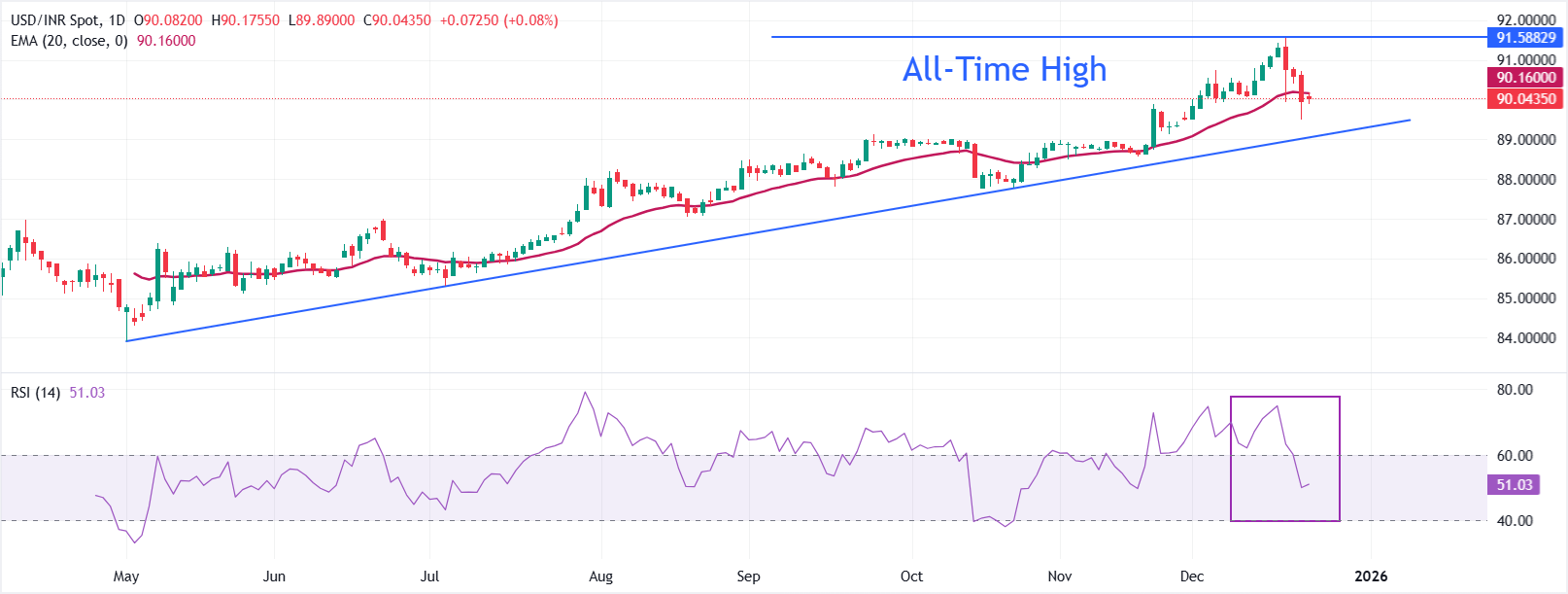
USD/INR trades cautiously near 90.0440 at the start of the week. The 20-day Exponential Moving Average rises, though price has slipped marginally below it at 90.1601, tempering near-term upside after a firm climb. The rising trend line from 83.9122 underpins the broader bias, with support aligned near 89.1107.
The 14-day Relative Strength Index (RSI) at 51 (neutral) confirms momentum has cooled from recent overbought readings.
Upside traction would improve on a sustained close back above the 20-day EMA that could press the price to revisit the all-time high near 91.50. Looking down, a break beneath the ascending trend line could open the door to a deeper pullback toward the November low of 88.49.
(The technical analysis of this story was written with the help of an AI tool.)
Indian economy FAQs
The Indian economy has averaged a growth rate of 6.13% between 2006 and 2023, which makes it one of the fastest growing in the world. India’s high growth has attracted a lot of foreign investment. This includes Foreign Direct Investment (FDI) into physical projects and Foreign Indirect Investment (FII) by foreign funds into Indian financial markets. The greater the level of investment, the higher the demand for the Rupee (INR). Fluctuations in Dollar-demand from Indian importers also impact INR.
India has to import a great deal of its Oil and gasoline so the price of Oil can have a direct impact on the Rupee. Oil is mostly traded in US Dollars (USD) on international markets so if the price of Oil rises, aggregate demand for USD increases and Indian importers have to sell more Rupees to meet that demand, which is depreciative for the Rupee.
Inflation has a complex effect on the Rupee. Ultimately it indicates an increase in money supply which reduces the Rupee’s overall value. Yet if it rises above the Reserve Bank of India’s (RBI) 4% target, the RBI will raise interest rates to bring it down by reducing credit. Higher interest rates, especially real rates (the difference between interest rates and inflation) strengthen the Rupee. They make India a more profitable place for international investors to park their money. A fall in inflation can be supportive of the Rupee. At the same time lower interest rates can have a depreciatory effect on the Rupee.
India has run a trade deficit for most of its recent history, indicating its imports outweigh its exports. Since the majority of international trade takes place in US Dollars, there are times – due to seasonal demand or order glut – where the high volume of imports leads to significant US Dollar- demand. During these periods the Rupee can weaken as it is heavily sold to meet the demand for Dollars. When markets experience increased volatility, the demand for US Dollars can also shoot up with a similarly negative effect on the Rupee.

 Copy Link
 Share on Facebook
 Share on X
 Share by Email