Gold sticks to gains near three-week high as Fed rate cut bets offset modest USD uptick

- Gold attracts some follow-through positive traction amid bets for more rate cuts by the Fed.
- Economic concerns stemming from the US government shutdown also benefit the commodity.
- The upbeat market mood and a modest USD uptick do little to dent the XAU/USD bullish tone.
Gold (XAU/USD) sticks to modest intraday gains through the first half of the European session and currently trades just below a nearly three-week high touched this Tuesday. Worries about the potential economic fallout from the longest-ever US government shutdown turned out to be a key factor that continues to underpin demand for the safe-haven commodity. Apart from this, bets for another rate cut by the US Federal Reserve (Fed) in December further act as a tailwind for the non-yielding yellow metal.
Meanwhile, a positive development towards reopening the US government provides an additional boost to the already upbeat market mood. Apart from this, the emergence of some US Dollar (USD) buying is holding back traders from placing aggressive bullish bets around the XAU/USD pair amid relatively thin trading volumes on the back of a bank holiday in the US. However, dovish Fed expectations could limit USD gains and suggest that the path of least resistance for the Gold price is to the upside.
Daily Digest Market Movers: Gold remains well supported by economic concerns and dovish Fed expectations
- The Senate late on Sunday reached a compromise and moved forward on a measure aimed at ending the longest US government shutdown in American history that began on October 1. Investors keenly await the expected flood of delayed data to shed more light on growth amid fears about an economic fallout from the US government closure.
- In fact, the University of Michigan's Survey showed on Friday US Consumer Sentiment Index slumped to 50.3 in November, or the lowest level since June 2022, from the previous month's final reading of 53.6. Moreover, investors seem tilted towards a more dovish US Federal Reserve, which continues to lend support to the non-yielding Gold.
- According to the CME Group's FedWatch Tool, markets now see an over 60% chance of another rate cut by the Fed in December. This, in turn, fails to assist the US Dollar in attracting any meaningful buyers and favors the XAU/USD bulls. However, the risk-on environment warrants some caution before positioning for a further appreciating move.
- US banks will be closed on Tuesday in observance of Veterans Day, leaving the USD and the commodity at the mercy of Fed rate cut expectations. Hence, speeches from influential FOMC members on Wednesday will be looked for more cues about the Fed's future rate-cut path, which should provide a fresh impetus to the non-yielding yellow metal.
Gold consolidates gains below $4,155-4,160 pivotal resistance before the next leg higher
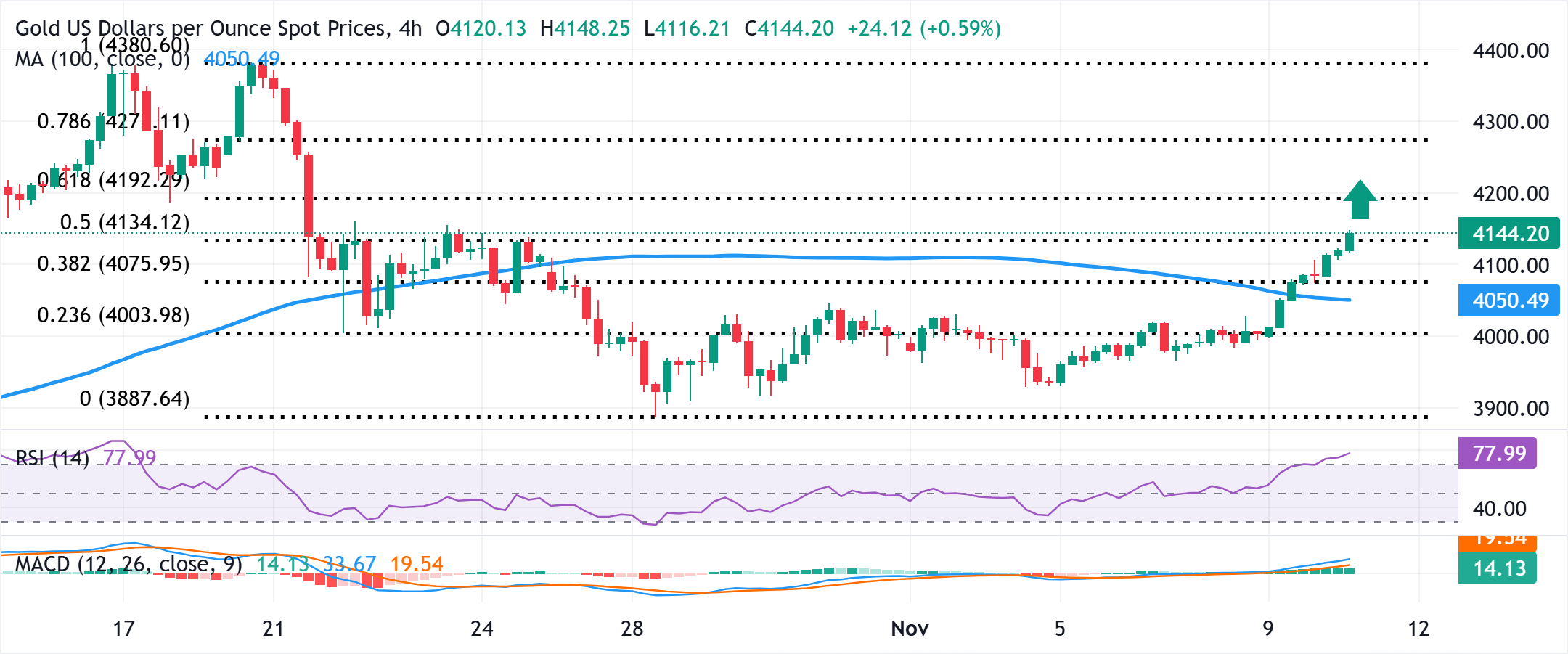
From a technical perspective, the XAU/USD pair now seems to have found acceptance above the 50% retracement level of the recent sharp corrective decline from the all-time peak, touched in October. This, along with positive oscillators on the daily chart, validates the near-term positive outlook for the Gold price. Some follow-through beyond the $4,155-4,160 area will reaffirm the bullish bias and allow the bullion to aim towards reclaiming the $4,200 round figure. The said handle nears the 61.8% Fibonacci retracement level, which, if cleared decisively, would set the stage for additional gains.
On the flip side, the Asian session low, around the $4,115 region, closely followed by the $4,100 round figure and the $4,075 region (38.2% Fibo. retracement level), now seems to protect the immediate downside. Failure to defend the said support levels might prompt some technical selling and drag the Gold price to the $4,025 region en route to the $4,000 psychological mark. A convincing break below the latter might shift the near-term bias in favor of bearish traders and make the XAU/USD pair vulnerable to accelerate the fall towards the $3,936-3,935 region before eventually dropping to the $3,900 round figure.
US Dollar FAQs
The US Dollar (USD) is the official currency of the United States of America, and the ‘de facto’ currency of a significant number of other countries where it is found in circulation alongside local notes. It is the most heavily traded currency in the world, accounting for over 88% of all global foreign exchange turnover, or an average of $6.6 trillion in transactions per day, according to data from 2022. Following the second world war, the USD took over from the British Pound as the world’s reserve currency. For most of its history, the US Dollar was backed by Gold, until the Bretton Woods Agreement in 1971 when the Gold Standard went away.
The most important single factor impacting on the value of the US Dollar is monetary policy, which is shaped by the Federal Reserve (Fed). The Fed has two mandates: to achieve price stability (control inflation) and foster full employment. Its primary tool to achieve these two goals is by adjusting interest rates. When prices are rising too quickly and inflation is above the Fed’s 2% target, the Fed will raise rates, which helps the USD value. When inflation falls below 2% or the Unemployment Rate is too high, the Fed may lower interest rates, which weighs on the Greenback.
In extreme situations, the Federal Reserve can also print more Dollars and enact quantitative easing (QE). QE is the process by which the Fed substantially increases the flow of credit in a stuck financial system. It is a non-standard policy measure used when credit has dried up because banks will not lend to each other (out of the fear of counterparty default). It is a last resort when simply lowering interest rates is unlikely to achieve the necessary result. It was the Fed’s weapon of choice to combat the credit crunch that occurred during the Great Financial Crisis in 2008. It involves the Fed printing more Dollars and using them to buy US government bonds predominantly from financial institutions. QE usually leads to a weaker US Dollar.
Quantitative tightening (QT) is the reverse process whereby the Federal Reserve stops buying bonds from financial institutions and does not reinvest the principal from the bonds it holds maturing in new purchases. It is usually positive for the US Dollar.

 Copy Link
 Share on Facebook
 Share on X
 Share by Email