Gold steadies as mixed US data and dovish Fed expectations pressure the Dollar

- Gold steadies as traders assess mixed US economic data and softer labour-market signals.
- Dovish Fed bets and central-bank buying continue to underpin XAU/USD.
- Price action shows Gold consolidating near the 21 SMA on the 4H chart, leaving the near-term tone mixed as momentum softens.
Gold (XAU/USD) firms as traders react to the latest US economic releases. At the time of writing, XAU/USD is trading around $4,225, edging modestly higher after briefly slipping below the $4,200 psychological level earlier in the day.
The latest US data painted a mixed picture of underlying economic momentum. ISM Services PMI rose slightly to 52.6 in November from 52.4, beating expectations of 52.1 and signalling steady expansion. Meanwhile, the ADP Employment Change report showed private-sector payrolls falling by 32,000 in November, sharply missing forecasts for a 5,000 gain. October’s figure was revised up to a 47,000 increase.
The private employment data underscored weakening labour conditions in the US. The report also holds significance as October’s Nonfarm Payrolls (NFP) will be published together with the November report on December 16, leaving the Federal Reserve (Fed) with few indicators to gauge labour conditions ahead of next week’s monetary policy meeting.
According to the CME FedWatch Tool, markets already price in about an 88% chance of a 25-basis-point (bps) reduction, keeping the US Dollar (USD) on the back foot and offering a broadly supportive backdrop for Gold.
Elsewhere, geopolitical tensions remain elevated after US envoys’ talks with Moscow on the Ukraine conflict failed to deliver meaningful progress.
Market movers: Dovish Fed signals and central bank demand keep Gold bid
- The ISM Services PMI report showed softer underlying momentum, with New Orders easing to 52.9 from 56.2 and the Employment Index contracting for a sixth straight month at 48.9. The Prices Index fell to 65.4 from 70.0, its lowest since April. A separate report from S&P Global also pointed to moderating activity, with the final Services PMI slipping to 54.1 from 55.0 and the Composite PMI easing to 54.2 from 54.8.
- US President Donald Trump said on Tuesday that he will announce his nominee for the next Fed Chair in early 2026. This follows his comment on Sunday, “I know who I am going to pick, yeah. We’ll be announcing it.” NEC Director Kevin Hassett has emerged as a leading contender, and markets view his potential appointment as paving the way for a more dovish policy stance.
- Dovish Fed expectations remain a drag on the US Dollar. The US Dollar Index (DXY), which tracks the Greenback's value against a basket of six major currencies, is hovering near its lowest level since October 30, around 98.99 and marking a seventh consecutive day of declines.
- US envoy Steve Witkoff met Russian President Vladimir Putin in Moscow on Tuesday to discuss US proposals to end the war in Ukraine, but the meeting ended without any breakthrough. Putin’s foreign policy advisor, Yuri Ushakov, described the talks as “constructive and very informative,” though he admitted that “a compromise hasn’t been reached yet” on key territorial issues. He added that discussions would continue.
- According to a World Gold Council (WGC) report published on December 2, central banks ramped up gold purchases in October, adding a net 53 tonnes, the largest monthly increase so far this year and 36% higher than September.
Technical analysis: XAU/USD stalls near 21 SMA as momentum softens
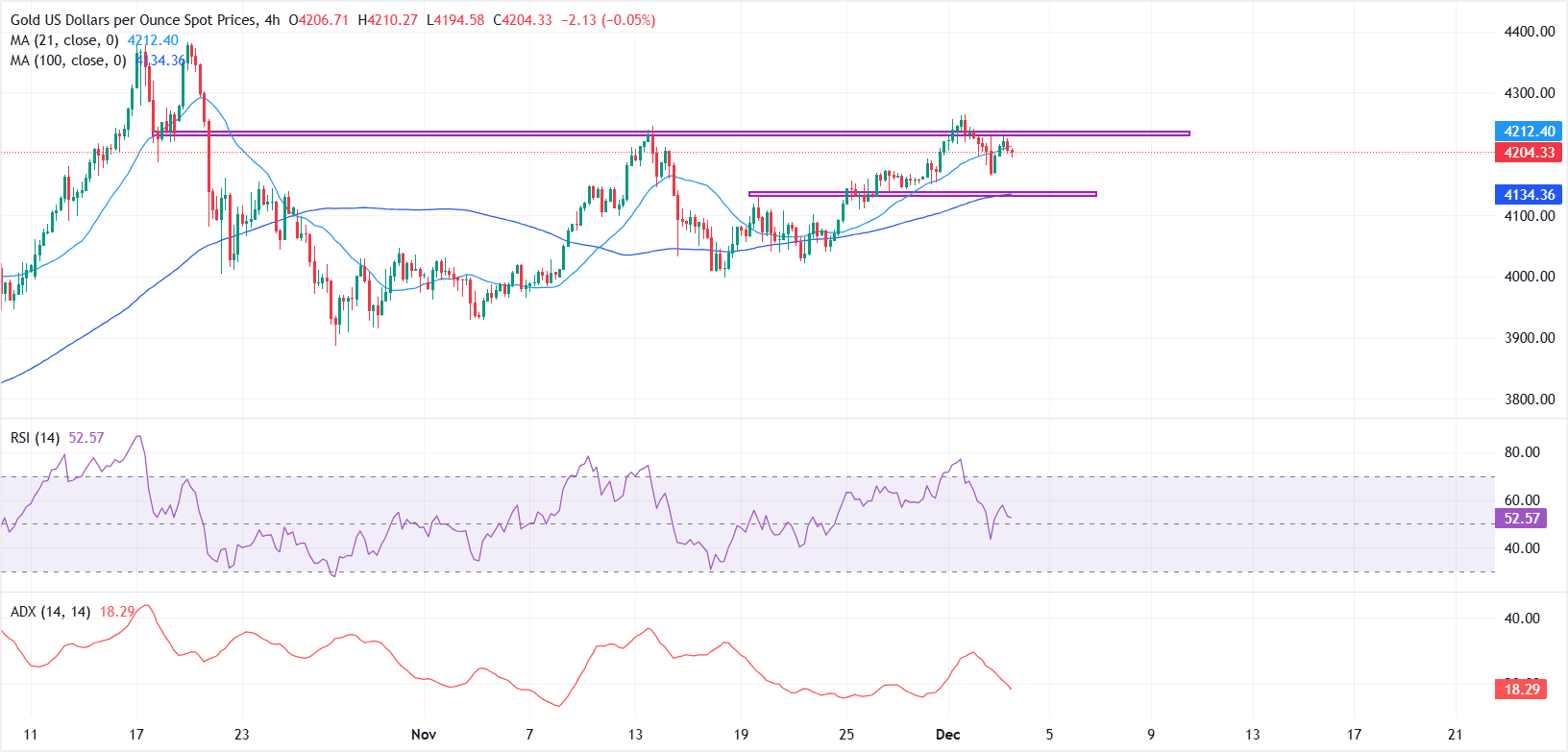
In the 4-hour chart, the 21-period Simple Moving Average (SMA) rises above the 100-period SMA, preserving a broader bullish structure. Price sits beneath the 21 SMA at $4,212.44 while holding above the 100 SMA at $4,134.37, keeping the near-term tone mixed. The 14-period Relative Strength Index (RSI) stands at 52.84, neutral, after cooling from overbought territory.
Momentum has softened, with the 14-period Average Directional Index easing to 18.29, pointing to limited trend strength. A decisive move above the 21 SMA would reenergize the upside and put buyers back in control, while failure to regain that level could keep XAU/USD capped and risk a drift toward dynamic support, with the rising 100 SMA underpinning the broader uptrend.
(The technical analysis of this story was written with the help of an AI tool)
Gold FAQs
Gold has played a key role in human’s history as it has been widely used as a store of value and medium of exchange. Currently, apart from its shine and usage for jewelry, the precious metal is widely seen as a safe-haven asset, meaning that it is considered a good investment during turbulent times. Gold is also widely seen as a hedge against inflation and against depreciating currencies as it doesn’t rely on any specific issuer or government.
Central banks are the biggest Gold holders. In their aim to support their currencies in turbulent times, central banks tend to diversify their reserves and buy Gold to improve the perceived strength of the economy and the currency. High Gold reserves can be a source of trust for a country’s solvency. Central banks added 1,136 tonnes of Gold worth around $70 billion to their reserves in 2022, according to data from the World Gold Council. This is the highest yearly purchase since records began. Central banks from emerging economies such as China, India and Turkey are quickly increasing their Gold reserves.
Gold has an inverse correlation with the US Dollar and US Treasuries, which are both major reserve and safe-haven assets. When the Dollar depreciates, Gold tends to rise, enabling investors and central banks to diversify their assets in turbulent times. Gold is also inversely correlated with risk assets. A rally in the stock market tends to weaken Gold price, while sell-offs in riskier markets tend to favor the precious metal.
The price can move due to a wide range of factors. Geopolitical instability or fears of a deep recession can quickly make Gold price escalate due to its safe-haven status. As a yield-less asset, Gold tends to rise with lower interest rates, while higher cost of money usually weighs down on the yellow metal. Still, most moves depend on how the US Dollar (USD) behaves as the asset is priced in dollars (XAU/USD). A strong Dollar tends to keep the price of Gold controlled, whereas a weaker Dollar is likely to push Gold prices up.

 Copy Link
 Share on Facebook
 Share on X
 Share by Email