Australian Dollar strengthens on RBA rate hike prospects

- Australian Dollar appreciates as the RBA Minutes indicated growing doubt that policy remains restrictive.
- RBA’s rate-hike expectations in February remain alive as Australia’s inflation rose to 3.8% in October from 3.6%.
- The US Dollar loses ground as expectations grow that the Fed will continue easing policy.
The Australian Dollar (AUD) advances against the US Dollar (USD) on Wednesday, continuing its winning streak for the third successive session. The AUD/USD pair strengthens as the Aussie Dollar finds support following the release of the Reserve Bank of Australia’s (RBA) December Meeting Minutes, which indicated that board members are becoming less confident that monetary policy remains sufficiently restrictive.
Australia’s headline inflation rose to 3.8% in October 2025 from 3.6% in September, remaining above the RBA’s 2–3% target range. As a result, markets are increasingly pricing in a rate hike as early as February 2026, with both the Commonwealth Bank of Australia and National Australia Bank projecting a rise to 3.85% at the RBA’s first policy meeting of the year.
The AUD/USD pair also appreciates as the US Dollar (USD) faces challenges amid growing expectations for two rate cuts by the Federal Reserve (Fed) in 2026, reinforced by President Donald Trump’s calls for lower borrowing costs.
US Dollar declines on Fed rate cut bets
- The US Dollar Index (DXY), which measures the value of the US Dollar against six major currencies, is losing ground and trading around 97.80 at the time of writing. The Greenback weakens in thin, holiday-shortened trading as expectations for further Fed rate cuts next year continued to weigh on sentiment.
- White House Adviser Kevin Hassett said on Tuesday that the Fed is not cutting interest rates quickly enough, even though the US economy grew at a much faster-than-expected pace in the third quarter, as per a CNBC report.
- The US Bureau of Economic Analysis (BEA) released delayed data showing that preliminary US Gross Domestic Product (GDP) Annualized expanded 4.3% in the July–September period. The reading exceeded market expectations of a 3.3% increase and surpassed the 3.8% growth recorded in the previous quarter.
- US core Personal Consumption Expenditures (PCE) Price Index rose by 2.9% quarter-over-quarter, matching analysts' estimates. In this period, the Gross Domestic Product Price Index was up 3.7%, compared to the market forecast of 2.7%.
- The Greenback faces challenges as precious metals rally, supported by safe-haven demand amid rising geopolitical tensions between the US and Venezuela. US President Donald Trump said on Monday that the US would keep and maybe sell the oil it had seized off the coast of Venezuela in recent weeks. Trump added that the US would also keep the seized ships.
- Federal Reserve Fed Member of the Board of Governors Stephen Miran said in an interview on Bloomberg TV on Monday that the last few months have seen data consistent with his view of the world and that he doesn’t see a recession in the near term. Miran said that failing to ease policy would raise recession risks, adding that the need to dissent for 50 basis points diminishes over time as rates are reduced.
- The CME FedWatch tool shows an 85.6% probability of rates being held at the Fed’s January meeting, up from 80.1% a day earlier. Meanwhile, the likelihood of a 25-basis-point rate cut has fallen to 14.4% from 19.9% a day ago.
- Federal Reserve Bank of Cleveland President Beth Hammack said on Sunday that monetary policy is in a good position to pause and assess the effects of the 75-basis-point (bps) rate cuts on the economy during the first quarter, according to Bloomberg. Meanwhile, Governor Miran reiterated last week that further easing is warranted, citing signs that inflation has cooled.
- The People’s Bank of China (PBOC), China's central bank, announced on Monday to leave its Loan Prime Rates (LPRs) unchanged. The one- and five-year LPRs were at 3.00% and 3.50%, respectively.
- Australia’s Consumer Inflation Expectations, which rose to 4.7% in December from November’s three-month low of 4.5%, support the Reserve Bank of Australia’s (RBA) hawkish stance.
Australian Dollar tests 14-month highs above 0.6700
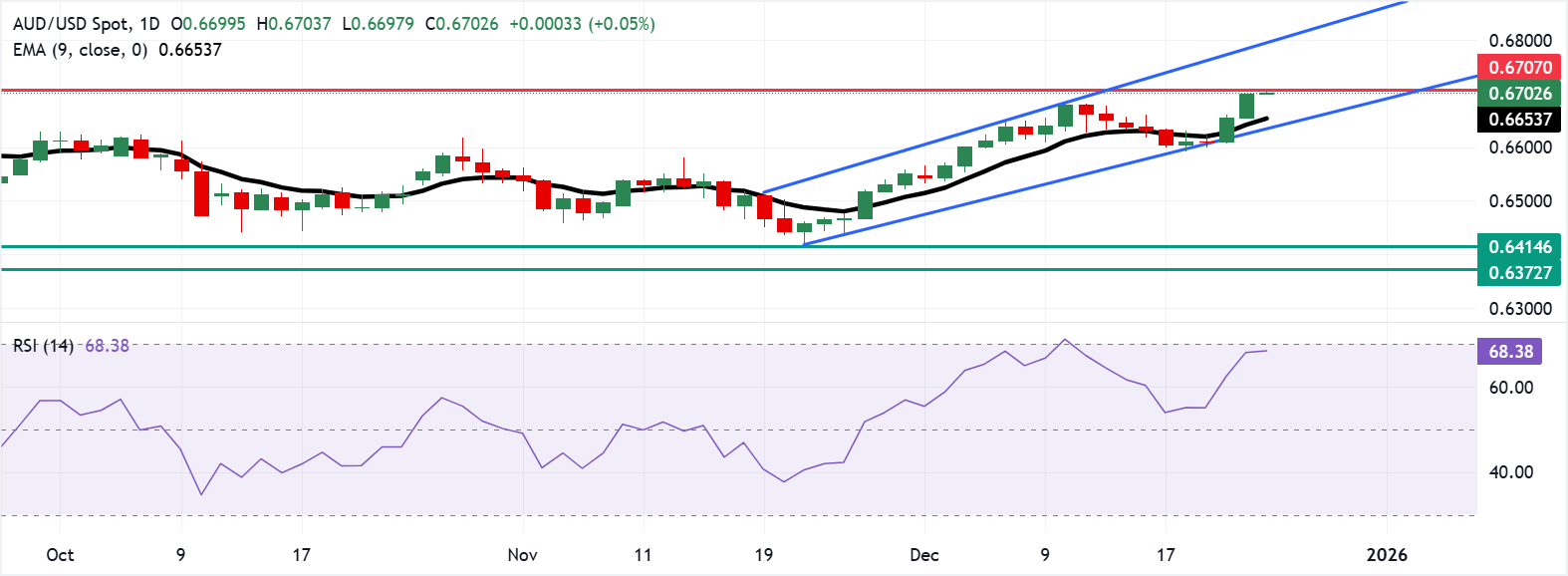
The AUD/USD pair is trading below 0.6700 on Wednesday. The technical analysis of the daily chart shows the pair is moving upwards within the ascending channel boundary, indicating the strengthening of a bullish bias. The 14-day Relative Strength Index (RSI) stands at 68.38, reflecting bullish conditions and building momentum.
The immediate barrier lies at 0.6707, the highest since October 2024. A break above this level would support the AUD/USD pair to explore the region around the upper boundary of the ascending channel at 0.6790.
On the downside, the AUD/USD pair may retreat toward the nine-day Exponential Moving Average (EMA) at 0.6653, followed by the lower ascending channel boundary around 0.6640. A break below the channel would expose the six-month low near 0.6414, marked on August 21.
Australian Dollar Price Today
The table below shows the percentage change of Australian Dollar (AUD) against listed major currencies today. Australian Dollar was the strongest against the US Dollar.
| USD | EUR | GBP | JPY | CAD | AUD | NZD | CHF | |
|---|---|---|---|---|---|---|---|---|
| USD | -0.10% | -0.22% | -0.39% | -0.11% | -0.16% | -0.21% | -0.15% | |
| EUR | 0.10% | -0.11% | -0.29% | -0.01% | -0.05% | -0.10% | -0.05% | |
| GBP | 0.22% | 0.11% | -0.19% | 0.10% | 0.07% | 0.01% | 0.07% | |
| JPY | 0.39% | 0.29% | 0.19% | 0.27% | 0.24% | 0.18% | 0.25% | |
| CAD | 0.11% | 0.01% | -0.10% | -0.27% | -0.06% | -0.12% | -0.05% | |
| AUD | 0.16% | 0.05% | -0.07% | -0.24% | 0.06% | -0.05% | -0.08% | |
| NZD | 0.21% | 0.10% | -0.01% | -0.18% | 0.12% | 0.05% | 0.06% | |
| CHF | 0.15% | 0.05% | -0.07% | -0.25% | 0.05% | 0.08% | -0.06% |
The heat map shows percentage changes of major currencies against each other. The base currency is picked from the left column, while the quote currency is picked from the top row. For example, if you pick the Australian Dollar from the left column and move along the horizontal line to the US Dollar, the percentage change displayed in the box will represent AUD (base)/USD (quote).
RBA FAQs
The Reserve Bank of Australia (RBA) sets interest rates and manages monetary policy for Australia. Decisions are made by a board of governors at 11 meetings a year and ad hoc emergency meetings as required. The RBA’s primary mandate is to maintain price stability, which means an inflation rate of 2-3%, but also “..to contribute to the stability of the currency, full employment, and the economic prosperity and welfare of the Australian people.” Its main tool for achieving this is by raising or lowering interest rates. Relatively high interest rates will strengthen the Australian Dollar (AUD) and vice versa. Other RBA tools include quantitative easing and tightening.
While inflation had always traditionally been thought of as a negative factor for currencies since it lowers the value of money in general, the opposite has actually been the case in modern times with the relaxation of cross-border capital controls. Moderately higher inflation now tends to lead central banks to put up their interest rates, which in turn has the effect of attracting more capital inflows from global investors seeking a lucrative place to keep their money. This increases demand for the local currency, which in the case of Australia is the Aussie Dollar.
Macroeconomic data gauges the health of an economy and can have an impact on the value of its currency. Investors prefer to invest their capital in economies that are safe and growing rather than precarious and shrinking. Greater capital inflows increase the aggregate demand and value of the domestic currency. Classic indicators, such as GDP, Manufacturing and Services PMIs, employment, and consumer sentiment surveys can influence AUD. A strong economy may encourage the Reserve Bank of Australia to put up interest rates, also supporting AUD.
Quantitative Easing (QE) is a tool used in extreme situations when lowering interest rates is not enough to restore the flow of credit in the economy. QE is the process by which the Reserve Bank of Australia (RBA) prints Australian Dollars (AUD) for the purpose of buying assets – usually government or corporate bonds – from financial institutions, thereby providing them with much-needed liquidity. QE usually results in a weaker AUD.
Quantitative tightening (QT) is the reverse of QE. It is undertaken after QE when an economic recovery is underway and inflation starts rising. Whilst in QE the Reserve Bank of Australia (RBA) purchases government and corporate bonds from financial institutions to provide them with liquidity, in QT the RBA stops buying more assets, and stops reinvesting the principal maturing on the bonds it already holds. It would be positive (or bullish) for the Australian Dollar.

 Copy Link
 Share on Facebook
 Share on X
 Share by Email