Gold edges higher as investors weigh mixed US jobs data

- Gold steadies after rebounding from intraday lows as traders digest the delayed US jobs report.
- November NFP beats expectations, but the Unemployment Rate climbs to its highest level since September 2021.
- Technically, Gold shows signs of near-term consolidation after repeated rejection near the $4,350 area, even as the broader uptrend remains intact.
Gold (XAU/USD) edges higher on Tuesday as traders digest the delayed US jobs report. At the time of writing, XAU/USD is trading around $4,315 after rebounding from a daily low near $4,271 touched earlier in the European session.
The US Bureau of Labor Statistics (BLS) reported that Nonfarm Payrolls (NFP) rose by 64,000 in November, beating market expectations of 50,000. In contrast, October payrolls declined by 105,000, reflecting distortions linked to the recent government shutdown. Meanwhile, September job gains were revised down to 108,000 from an initial estimate of 119,000.
The Unemployment Rate rose to 4.6% in November, above market expectations, marking its highest level since September 2021. The uptick adds to evidence of cooling conditions in the US labour market.
The Fed’s monetary policy path has continued to dominate market sentiment since last week’s 25 basis point (bps) rate cut. The central bank has delivered 75 bps of easing this year amid signs of labour market cooling, even as inflation remains above the 2% target.
Market movers: Peace-talk optimism, US jobs data and Fed signals in focus
- US Retail Sales were flat on a monthly basis in October at 0.0%, missing expectations for a 0.1% increase, while annual sales growth slowed to 3.5% from 4.2%. However, the Retail Sales Control Group rose 0.8%, beating forecasts of 0.3%, while sales excluding autos increased 0.4%, also above expectations of 0.3%.
- Reports of progress in US-led Russia-Ukraine peace talks have modestly eased geopolitical tensions, limiting safe-haven flows into Gold. Ukrainian officials described “real progress” from peace talks in Berlin, saying negotiations with US envoys have been constructive and productive, including discussions around strong security guarantees for Kyiv. US President Donald Trump echoed the optimism, saying a peace deal is “closer now than we have been, ever,” while senior US officials indicated Washington is prepared to offer NATO-style security guarantees as part of a negotiated framework.
- At last week’s Federal Open Market Committee (FOMC) meeting, Fed Chair Jerome Powell said the central bank is “well-positioned to wait and see how the economy evolves.” Even so, policymakers remain divided over the need for additional easing in 2026, leaving investors uncertain about the policy outlook. Markets are largely pricing in a hold in January, with nearly a 40% probability of a rate cut in March, according to the CME FedWatch Tool.
- New York Fed President John Williams said on Monday that monetary policy is well-positioned as the US heads into 2026, noting that inflation is expected to moderate further while labour-market risks have increased.
- In contrast, Fed Governor Stephen Miran reiterated his dovish stance, arguing that underlying inflation pressures are lower than headline measures suggest and cautioning against keeping policy overly restrictive. Miran, who favoured a larger 50 basis point rate cut at the last meeting, said a faster pace of easing would move policy closer to the neutral rate, warning that holding policy too tight risks unnecessary job losses. He added that future dissents will depend on policy decisions and said he would like rates to decline further.
- Markets are also closely monitoring developments around the potential Fed leadership change, with Reuters reporting that Kevin Hassett’s candidacy has faced pushback from individuals close to President Donald Trump, shifting attention toward former Fed Governor Kevin Warsh, who is increasingly seen as the leading contender to succeed Chair Jerome Powell, whose term ends in May 2026.
Technical analysis: XAU/USD eyes $4,250 support after failing near $4,350
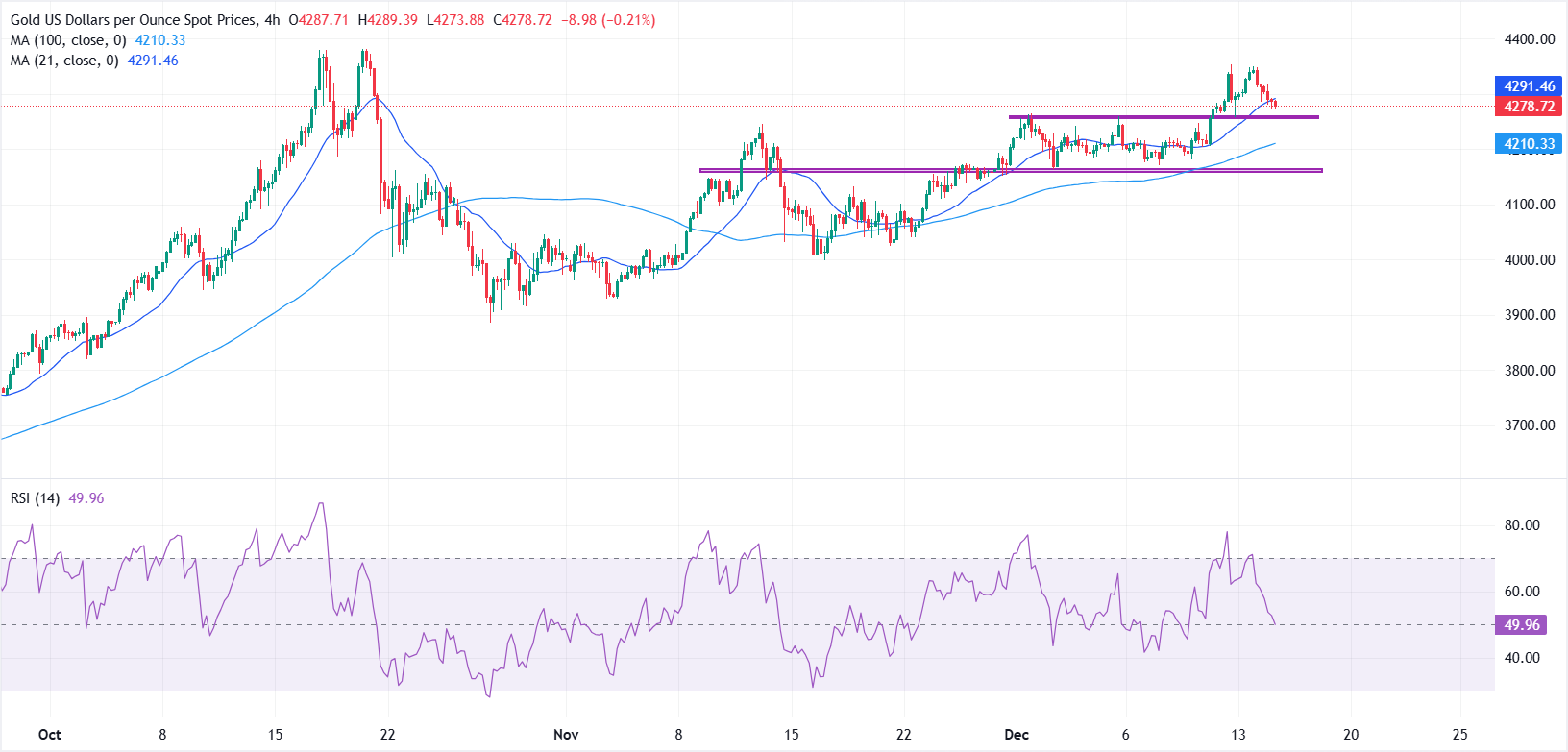
From a technical perspective, Gold’s near-term bias has turned slightly bearish to neutral after sellers once again stepped in near the $4,350 region, pushing prices lower from recent highs.
On the 4-hour chart, XAU/USD is trading below the 21-period Simple Moving Average (SMA), near $4,291, which is acting as immediate resistance and signalling that sellers retain short-term control.
A sustained move back above this level would be needed to ease downside pressure, with the next upside hurdle seen around $4,350, ahead of a potential retest of the all-time high near $4,381.
On the downside, $4,250 marks immediate support, while the 100-period SMA at $4,210.31 provides a key dynamic support zone. As long as prices hold above the rising 100-period SMA, the broader uptrend remains intact. However, a decisive break below this level would tilt the near-term structure lower.
Meanwhile, the Relative Strength Index (RSI) has slipped back toward the neutral 50 area, reflecting fading bullish momentum and reinforcing the view that Gold may remain in short-term consolidation before attempting another leg higher.
Gold FAQs
Gold has played a key role in human’s history as it has been widely used as a store of value and medium of exchange. Currently, apart from its shine and usage for jewelry, the precious metal is widely seen as a safe-haven asset, meaning that it is considered a good investment during turbulent times. Gold is also widely seen as a hedge against inflation and against depreciating currencies as it doesn’t rely on any specific issuer or government.
Central banks are the biggest Gold holders. In their aim to support their currencies in turbulent times, central banks tend to diversify their reserves and buy Gold to improve the perceived strength of the economy and the currency. High Gold reserves can be a source of trust for a country’s solvency. Central banks added 1,136 tonnes of Gold worth around $70 billion to their reserves in 2022, according to data from the World Gold Council. This is the highest yearly purchase since records began. Central banks from emerging economies such as China, India and Turkey are quickly increasing their Gold reserves.
Gold has an inverse correlation with the US Dollar and US Treasuries, which are both major reserve and safe-haven assets. When the Dollar depreciates, Gold tends to rise, enabling investors and central banks to diversify their assets in turbulent times. Gold is also inversely correlated with risk assets. A rally in the stock market tends to weaken Gold price, while sell-offs in riskier markets tend to favor the precious metal.
The price can move due to a wide range of factors. Geopolitical instability or fears of a deep recession can quickly make Gold price escalate due to its safe-haven status. As a yield-less asset, Gold tends to rise with lower interest rates, while higher cost of money usually weighs down on the yellow metal. Still, most moves depend on how the US Dollar (USD) behaves as the asset is priced in dollars (XAU/USD). A strong Dollar tends to keep the price of Gold controlled, whereas a weaker Dollar is likely to push Gold prices up.

 Copy Link
 Share on Facebook
 Share on X
 Share by Email