Gold stays supported amid cautious Fed outlook and geopolitical risks

- Gold holds firm below record highs as uncertainty over the Federal Reserve’s monetary policy outlook keeps traders defensive.
- Central bank buying, ETF inflows, and geopolitical risks continue to support prices.
- Technicals remain constructive, with bulls targeting a break above $4,350.
Gold (XAU/USD) kicks off the week on a firm footing, extending its advance for a fifth consecutive day as uncertainty over the Federal Reserve’s (Fed) monetary policy outlook keeps traders defensive. At the time of writing, XAU/USD is trading around $4,330, as buyers struggle to clear the $4,350 mark.
From a broader macro perspective, the metal remains supported by persistent geopolitical tensions. At the same time, continued strong central bank demand and robust inflows into Gold-backed exchange-traded funds (ETFs) are providing a steady tailwind for prices.
Investors are also positioning for a busy US economic calendar in the days ahead, with upcoming data likely to shape expectations around the Fed's policy path into 2026. The spotlight this week falls on the delayed October and November Nonfarm Payrolls (NFP) report, due to be released on Tuesday, followed by the Consumer Price Index (CPI) on Thursday.
Market movers: Markets stay defensive amid China slowdown and cautious Fed signals
- China’s latest economic indicators highlighted a broadening slowdown in the world’s second-largest economy, with November industrial output expanding 4.8% year-on-year, below expectations and slightly slower than October, while retail sales rose just 1.3%, marking their weakest gain since late 2022. The softer data have reinforced concerns about global growth, supporting risk-averse sentiment and underpinning safe-haven demand for Gold.
- Geopolitical tensions remain elevated amid stalled US-led peace talks between Russia and Ukraine. Reuters reported that Ukrainian President Volodymyr Zelenskiy offered to drop Ukraine’s bid to join the NATO military alliance in exchange for Western security guarantees, as part of efforts to end the war with Russia. The proposal would meet one of Moscow’s key war aims, although Kyiv has so far held firm against ceding territory to Russia.
- The Fed lowered borrowing costs by 25 basis points (bps) last week in a 9-3 vote, bringing the policy rate to a 3.50%-3.75% range, and signalled a “wait-and-see” approach to further easing as policymakers balance ongoing labour-market softness against still-sticky inflation.
- In the post-meeting press conference, Fed Chair Jerome Powell said the central bank is “well positioned to wait and see how the economy evolves,” while acknowledging risks on both sides of the Fed’s dual mandate. The relatively less hawkish tone prompted traders to price in two rate cuts next year, even as the latest dot plot points to just one.
- Two of the three dissenters, including Chicago Fed President Austan Goolsbee and Kansas City Fed President Jeffrey Schmid, preferred to leave rates unchanged. Goolsbee said on Friday he favoured waiting for greater clarity on inflation before easing further, while Schmid argued that little had changed since the previous meeting, emphasising that inflation remains too high and the economy still shows momentum with a labor market that’s cooling but largely balanced.
- Fed Governor Stephen Miran reiterated his dovish stance on Monday, arguing that underlying inflation pressures are lower than headline measures suggest and cautioning against keeping policy overly restrictive. He said shelter inflation reflects past imbalances rather than current demand, while market-based core inflation is already close to the Fed’s 2% target. Miran, who favoured a larger 50 basis point rate cut at the last meeting, added that a faster pace of easing would move policy closer to the neutral rate and warned that holding policy too tight risks job losses.
Technical analysis: Bulls eye a break above $4,350
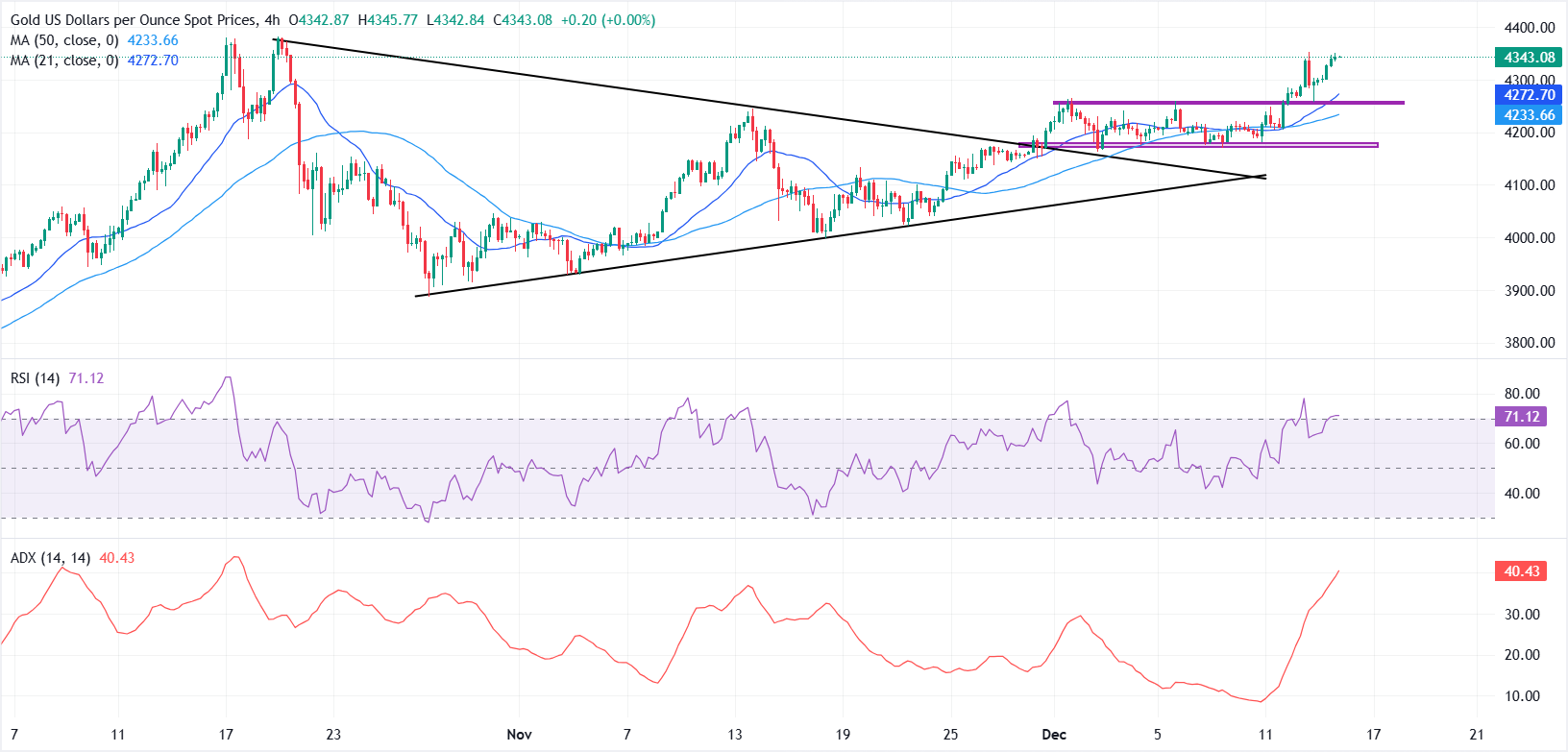
From a technical perspective, Gold’s broader structure remains constructive following a bullish continuation move above a symmetrical triangle pattern. On the upside, immediate resistance is seen near the $4,350 level, ahead of a potential retest of the all-time high around $4,381.
On the downside, the former breakout zone near $4,250 now acts as a key initial support, followed by the rising 50-period Simple Moving Average (SMA) at $4,233. A deeper corrective pullback could attract fresh buying interest in the $4,180-$4,170 region.
Momentum indicators also support the upside, with the Relative Strength Index (RSI) holding above 70, signalling strong bullish momentum, while the Average Directional Index (ADX) at 40 has turned sharply higher, pointing to strengthening trend conditions.
Gold FAQs
Gold has played a key role in human’s history as it has been widely used as a store of value and medium of exchange. Currently, apart from its shine and usage for jewelry, the precious metal is widely seen as a safe-haven asset, meaning that it is considered a good investment during turbulent times. Gold is also widely seen as a hedge against inflation and against depreciating currencies as it doesn’t rely on any specific issuer or government.
Central banks are the biggest Gold holders. In their aim to support their currencies in turbulent times, central banks tend to diversify their reserves and buy Gold to improve the perceived strength of the economy and the currency. High Gold reserves can be a source of trust for a country’s solvency. Central banks added 1,136 tonnes of Gold worth around $70 billion to their reserves in 2022, according to data from the World Gold Council. This is the highest yearly purchase since records began. Central banks from emerging economies such as China, India and Turkey are quickly increasing their Gold reserves.
Gold has an inverse correlation with the US Dollar and US Treasuries, which are both major reserve and safe-haven assets. When the Dollar depreciates, Gold tends to rise, enabling investors and central banks to diversify their assets in turbulent times. Gold is also inversely correlated with risk assets. A rally in the stock market tends to weaken Gold price, while sell-offs in riskier markets tend to favor the precious metal.
The price can move due to a wide range of factors. Geopolitical instability or fears of a deep recession can quickly make Gold price escalate due to its safe-haven status. As a yield-less asset, Gold tends to rise with lower interest rates, while higher cost of money usually weighs down on the yellow metal. Still, most moves depend on how the US Dollar (USD) behaves as the asset is priced in dollars (XAU/USD). A strong Dollar tends to keep the price of Gold controlled, whereas a weaker Dollar is likely to push Gold prices up.

 Copy Link
 Share on Facebook
 Share on X
 Share by Email