Gold extends rally to fresh three-week high amid Fed rate cut bets, bearish USD

- Gold attracts follow-through buyers on Thursday amid a supportive fundamental backdrop.
- Economic concerns and Fed rate cut bets undermine the USD, benefiting the precious metal.
- The optimism led by the reopening of the US government does little to cap the commodity.
Gold (XAU/USD) is seen prolonging its uptrend for the third straight day and scaling fresh three-week highs through the first half of the European session on Thursday. Investors seem convinced that the delayed US macro data will show some weakness in the economy amid a prolonged US government shutdown and prompt the US Federal Reserve (Fed) to lower borrowing costs further in December. This further acts as a tailwind for the non-yielding yellow metal.
Moreover, the prevalent US Dollar (USD) selling bias turns out to be another factor underpinning the Gold price. The XAU/USD bulls, meanwhile, seem rather unaffected by the optimism led by a positive development to reopen the US federal government, which remains supportive of a positive risk tone and tends to undermine the safe-haven commodity. This, along with acceptance above the $4,200 mark, suggests that the path of least resistance for the bullion is to the upside.
Daily Digest Market Movers: Gold bulls not ready to give up as dovish Fed bets continue to weigh on USD
- The US Senate passed the funding bill to end the longest-running government shutdown, which boosts investors' confidence and remains supportive of a generally positive risk tone. This, in turn, might hold back the XAU/USD bulls from placing fresh bets, especially after the recent strong rise to an over three-week high, touched on Wednesday.
- The reopening of the US government shifts market focus back to the deteriorating fiscal outlook and concerns about weakening economic momentum. Economists estimate that the prolonged government closure might have already shaved approximately 1.5 to 2.0% off quarterly GDP growth. This, in turn, keeps the US Dollar bulls on the defensive.
- Moreover, data from workforce analytics company Revelio Labs released last week showed that 9,100 jobs were lost in October and government payrolls fell by 22,200 positions last month. Furthermore, the Chicago Federal Reserve estimated that the unemployment rate edged up last month, pointing to signs of a deteriorating labor market.
- Adding to this, investors remain tilted towards a more dovish Fed and have been pricing in around a 60% chance of another 25-basis-point interest rate cut at the December FOMC policy meeting. This, in turn, is seen acting as a headwind for the Greenback and offering some support to the non-yielding Gold heading into the European session on Thursday.
- Atlanta Fed President Raphael Bostic said on Wednesday that real-time indicators signal the job market in a curious state of balance, and I do not view a severe labor market downturn as the most likely near-term outcome. I see little to suggest price pressures and moving policy lower risks feeding the inflation beast, Bostic added further.
- Traders will continue to scrutinize speeches from a slew of influential FOMC members for more cues about the Fed's future rate-cut path. The outlook, in turn, will play a key role in driving demand for the Greenback. Nevertheless, the fundamental backdrop suggests that the path of least resistance for the XAU/USD pair is to the upside.
Gold approaches $4,250-4,255 intermediate barrier; bullish potential seems intact
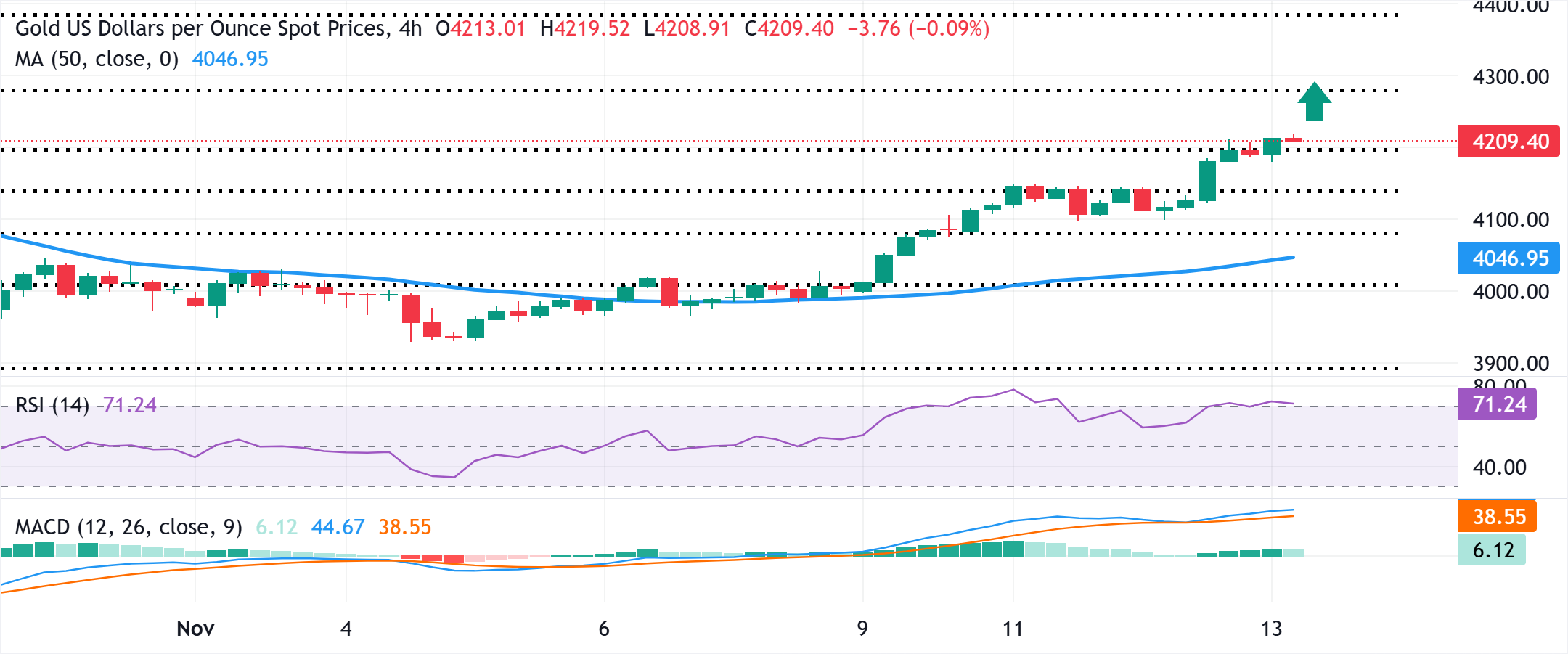
From a technical perspective, the XAU/USD pair now seems to have found acceptance above the 61.8% Fibonacci retracement level of the recent corrective decline from the all-time peak, touched in October, and the $4,200 round figure. This, along with positive oscillators on daily/4-hour charts, validates the constructive outlook for the Gold price. Hence, a subsequent strength towards the $4,250-$4,255 region, en route to the $4,285 zone and the $4,300 mark, looks like a distinct possibility.
On the flip side, any meaningful slide below the Asian session low, around the $4,180 region, might now be seen as a buying opportunity. This, in turn, should help limit the downside for the Gold price near the $4,100-$4,095 zone. The latter should act as a key pivotal point, which, if broken, might prompt some technical selling and drag the commodity to the $4,075 region, or the 38.2% Fibo. retracement level, en route to the $4,025 area. Some follow-through selling, leading to a further fall below the $4,000 psychological mark, might shift the near-term bias in favor of bearish traders and pave the way for deeper losses.
US Dollar Price Last 7 Days
The table below shows the percentage change of US Dollar (USD) against listed major currencies last 7 days. US Dollar was the strongest against the Japanese Yen.
| USD | EUR | GBP | JPY | CAD | AUD | NZD | CHF | |
|---|---|---|---|---|---|---|---|---|
| USD | -1.17% | -0.85% | 0.29% | -0.84% | -1.09% | -0.25% | -1.91% | |
| EUR | 1.17% | 0.32% | 1.46% | 0.32% | 0.07% | 0.92% | -0.75% | |
| GBP | 0.85% | -0.32% | 1.10% | 0.00% | -0.25% | 0.60% | -1.07% | |
| JPY | -0.29% | -1.46% | -1.10% | -1.15% | -1.39% | -0.58% | -2.19% | |
| CAD | 0.84% | -0.32% | -0.00% | 1.15% | -0.25% | 0.57% | -1.07% | |
| AUD | 1.09% | -0.07% | 0.25% | 1.39% | 0.25% | 0.85% | -0.84% | |
| NZD | 0.25% | -0.92% | -0.60% | 0.58% | -0.57% | -0.85% | -1.66% | |
| CHF | 1.91% | 0.75% | 1.07% | 2.19% | 1.07% | 0.84% | 1.66% |
The heat map shows percentage changes of major currencies against each other. The base currency is picked from the left column, while the quote currency is picked from the top row. For example, if you pick the US Dollar from the left column and move along the horizontal line to the Japanese Yen, the percentage change displayed in the box will represent USD (base)/JPY (quote).

 Copy Link
 Share on Facebook
 Share on X
 Share by Email