“AI Highlights Existing Problems and Makes Them Bigger”: Insight at FMLS:25 on Data Challenges

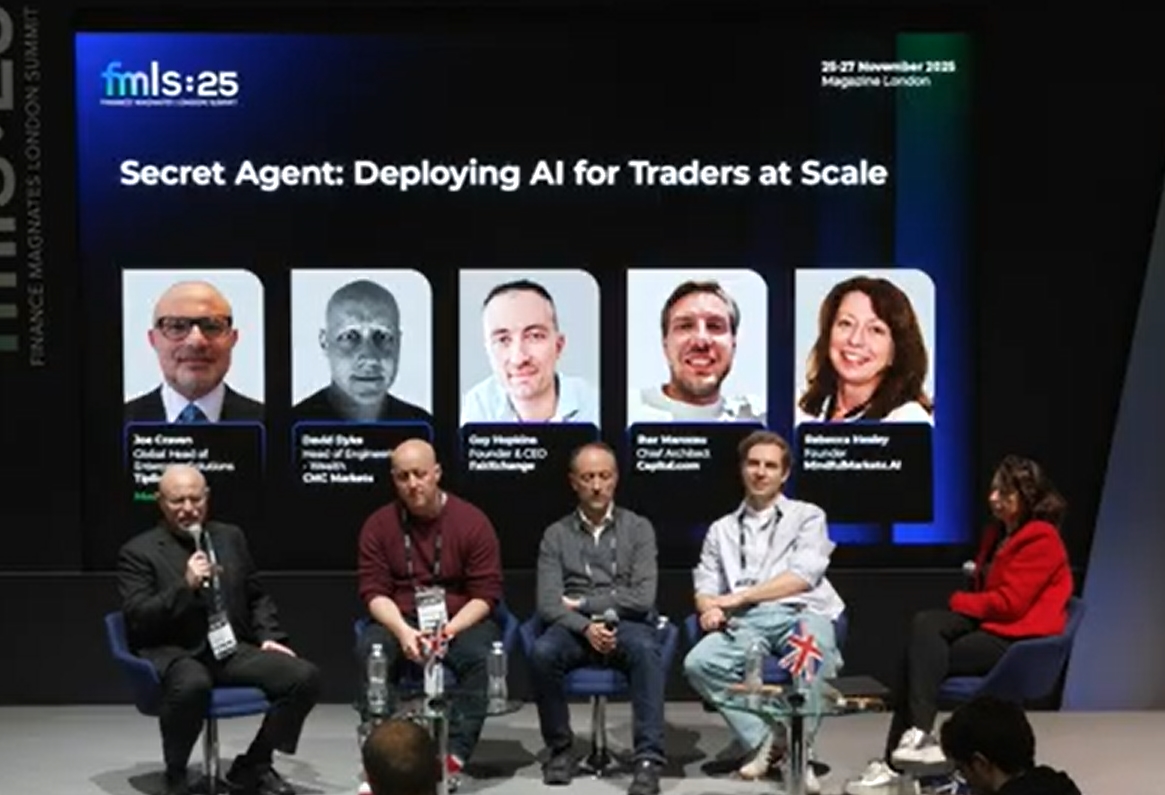
At the Finance Magnates London Summit 2025, industry leaders convened to discuss the changing role of artificial intelligence in trading during the panel “Secret Agent Deploying AI for Traders at Scale 1” Moderated by Joe Craven, Global Head of Enterprise Solutions at TipRanks, the session highlighted how AI is reshaping workflows, enhancing decision-making, and creating both opportunities and challenges for market participants.
Craven opened by framing AI as a tool to make complex data more digestible for retail investors, highlighting TipRanks’ work in integrating linguistic technology and machine learning into financial platforms. Panelists David Dyke, Head of Engineering - Wealth at CMC Markets, Guy Hopkins, Founder & CEO of FairXchange, Ihar Marozau, Chief Architect of Capital.com, and Rebecca Healey, Founder of MindfulMarkets.AI offered varied perspectives on AI adoption.
AI as a Tool for Retail Investors
Hopkins described AI as “a solution looking for a problem,” noting that while algorithmic and model-driven trading are well-established, interest has surged around generative AI and large language models. Healey added, “People can’t make sense of all the information coming at them. We’re potentially moving into the world of a headless EMS, where access to information is customizable and personal.”
Regulatory and Operational Challenges
Panelists highlighted compliance and operational hurdles. Marozau explained, “AI output must be auditable and explainable,” while Dyke cautioned, “You can use that to think that you’re making progress, but without it being checked correctly by the experts, you can’t explain why you’ve come to a particular conclusion.”
[#highlighted-links#]
Hopkins noted a human tendency to over-trust AI: “There is a kind of abdication of responsibility when people start to rely on these tools.”
Addressing risk mitigation, Healey emphasized accurate data and differentiating AI types: “An institutional asset manager building execution models may spend six months deciphering broker data before starting an AI model. AI has highlighted existing problems in the industry and made them bigger.”
Hopkins illustrated practical application: LLMs aren’t deployed directly in calculations due to unpredictability but are used to understand user intent and connect to deterministic agents. Dyke described similar implementations at CMC Markets, where AI monitors customer communications while human oversight remains critical.
Workforce Implications
The panel explored AI’s impact on workforce development. Dyke suggested AI could reduce friction for newcomers, supporting learning. Hopkins warned that automating junior tasks could limit experiential learning for developing senior professionals.
Healey countered, arguing AI allows learning to change: “Rather than just having learned experience on equities, you might need learned experience covering all asset classes, which you couldn’t do manually.” Marozau emphasized that knowledge is increasingly commoditized, shifting focus to conceptual understanding and adaptable user interfaces.
December 2025 Compliance Report: Key insights from CySEC’s Investor Guide 2025. Learn which practices to avoid, educate clients, and keep AI, digital tools & affiliates compliant. Download your Free report: https://t.co/gVs7w2T9h7#Compliance #CySEC pic.twitter.com/pgQfxPA23k
— Finance Magnates (@financemagnates) December 24, 2025
Practical Concerns and End-User Benefits
Audience questions raised concerns about AI maturity, mistakes, and overconfidence. Panelists highlighted VIP coding tools and experimentation frameworks that allow safe testing. Healey noted smaller firms and retail investors can experiment more freely than heavily regulated institutions.
Panelists repeatedly emphasized personalization and efficiency as main benefits. Healey said AI enables traders to respond rather than react, improving optionality across assets and regions. Hopkins added that AI helps users assimilate data quickly, enhancing decision-making. Dyke highlighted AI’s educational value, providing judgment-free environments for learning.
Same app, different users, different outcomes. Check out Microsoft Purview for user-aware protection.
— Microsoft Mechanics (@MSFTMechanics) December 8, 2025
https://t.co/crYxmCxyrJ #PurviewSDK #purview #datagovernance #microsoft #microsoft365 #microsoftsecurity pic.twitter.com/N9soZdCV0u
Risks and Market Considerations
The discussion touched on potential risks of accelerating workflows, such as increased volatility and momentum. Panelists stressed the necessity of keeping humans in the loop. Healey referenced the move from T+2 to T+1 settlement as an example of AI enabling fundamentally different market engagement rather than simply speeding up processes.
AI Advances Trading, Human Control Remains
Closing the panel, consensus was clear: AI in trading is a powerful but complex tool. Its transformative potential lies in personalization, data synthesis, and workflow automation, but human oversight, regulatory compliance, and rigorous data governance remain indispensable.
As Hopkins summarized, “Regulators and practitioners are all over AI getting it to production on the trading floor faces significant headwinds.”
The panel highlighted that while AI is reshaping the industry, success depends on combining machine intelligence with human judgment, ensuring both innovation and accountability in financial markets.

 Copy Link
 Share on Facebook
 Share on X
 Share by Email