Pound Sterling pares some gains as UK Retail Sales decline sharply in May

- The Pound Sterling surrenders some of its early gains on Friday after the UK Retail Sales data for May declined faster than expected.
- Month-on-month Retail Sales slumped by 2.7%, the largest drop seen since December 2023.
- The BoE held interest rates steady in its monetary policy announcement on Thursday.
The Pound Sterling (GBP) gives back some gains against its major peers on Friday after the release of the weaker-than-projected United Kingdom (UK) Retail Sales data for May. Still, the British currency trades higher against a majority of its peers.
The Office for National Statistics (ONS) reported that Retail Sales, a key measure of consumer spending, declined by 2.7% on month, the sharpest drop seen since December 2023. Economists expected the consumer spending measure to have contracted at a moderate pace of 0.5% after expanding by 1.3% in April, upwardly revised from 1.2%.
Year-on-year Retail Sales unexpectedly declined by 1.3%, while they were anticipated to have grown by 1.7%. A significant slump in sales receipts at Department stores, and Textile Clothing & Footwear stores led to a sharp decline in the figures
Weak UK Retail Sales data often encourages traders to raise bets supporting more interest rate cuts from the Bank of England (BoE). Traders expect the BoE to cut its key borrowing rates two times in the remainder of the year after the monetary policy announcement on Thursday, in which the central bank kept them steady at 4.25%, as the consensus showed, with a 6-3 vote majority.
Three Monetary Policy Committee (MPC) members argued in favor of lowering interest rates again, citing that "a material loosening in labour market conditions" makes the case for further monetary policy easing.
BoE Governor Andrew Bailey retained the “gradual and careful” monetary easing guidance, stating that interest rates remain on a “gradual downward path”. He warned that softening labor market conditions and rising energy prices amid escalating Middle East tensions are key risks to the economy.
Going forward, the next trigger for the Pound Sterling will be the UK preliminary S&P Global/CIPS Purchasing Managers’ Index (PMI) data for June, which will be released on Monday.
British Pound PRICE Today
The table below shows the percentage change of British Pound (GBP) against listed major currencies today. British Pound was the weakest against the Euro.
| USD | EUR | GBP | JPY | CAD | AUD | NZD | CHF | |
|---|---|---|---|---|---|---|---|---|
| USD | -0.22% | -0.15% | -0.12% | -0.12% | -0.28% | -0.07% | -0.08% | |
| EUR | 0.22% | 0.05% | 0.10% | 0.11% | 0.12% | 0.17% | 0.18% | |
| GBP | 0.15% | -0.05% | 0.12% | 0.07% | 0.07% | 0.11% | 0.10% | |
| JPY | 0.12% | -0.10% | -0.12% | 0.06% | -0.17% | -0.09% | -0.01% | |
| CAD | 0.12% | -0.11% | -0.07% | -0.06% | -0.13% | -0.19% | 0.04% | |
| AUD | 0.28% | -0.12% | -0.07% | 0.17% | 0.13% | 0.33% | 0.03% | |
| NZD | 0.07% | -0.17% | -0.11% | 0.09% | 0.19% | -0.33% | -0.01% | |
| CHF | 0.08% | -0.18% | -0.10% | 0.01% | -0.04% | -0.03% | 0.01% |
The heat map shows percentage changes of major currencies against each other. The base currency is picked from the left column, while the quote currency is picked from the top row. For example, if you pick the British Pound from the left column and move along the horizontal line to the US Dollar, the percentage change displayed in the box will represent GBP (base)/USD (quote).
Daily digest market movers: Pound Sterling trades higher against US Dollar
- The Pound Sterling strives to break above the psychological level of 1.3500 against the US Dollar (USD) on Friday. The GBP/USD pair trades lower as the US Dollar corrects sharply after comments from the White House indicated that the United States (US) has no intention of striking Iran in the coming days, which lifted investors' risk appetite.
- No immediate plans to attack from Washington have also diminished the demand for safe-haven assets, sending the US Dollar Index (DXY) lower to near 98.60 from its weekly high of 99.15 posted on Thursday.
- “Based on the fact that there is a substantial chance that negotiations may or may not take place with Iran in the near future, I will make my decision whether or not to go, within the next two weeks,” Press Secretary Karoline Leavitt said on the behalf of US President Trump, ANI News reported.
- Financial market participants were anticipating that the US could join the Israeli Defence Forces (IDF) and accelerate airstrikes on Iran, aiming to prevent Tehran from building nuclear warheads. Fears of the US attacking Iran directly stemmed after a report from Bloomberg on Wednesday indicated that senior US officials are preparing for the possibility of a strike on Iran in the coming days. The news increased demand for safe-haven assets, such as the US Dollar.
- On Wednesday, fresh projections from the Federal Reserve (Fed) that it will cut interest rates fewer times in 2026 and 2027 than anticipated in March also supported the US Dollar. According to the Fed’s dot plot, policymakers collectively revised the interest rate target for 2026 and 2027 to 3.6% and 3.4%, respectively. In the policy meeting, the Fed held interest rates steady in the range of 4.25%-4.50% for the fourth straight meeting and warned of upside risks to inflation.
- For fresh cues on the inflation outlook, investors will focus on the flash US S&P Global PMI data for June, which is scheduled to be released on Monday. The PMI report will show the change in prices paid by business owners for inputs and selling prices amid the imposition of the tariff policy by US President Donald Trump.
Technical Analysis: Pound Sterling struggles around 20-day EMA
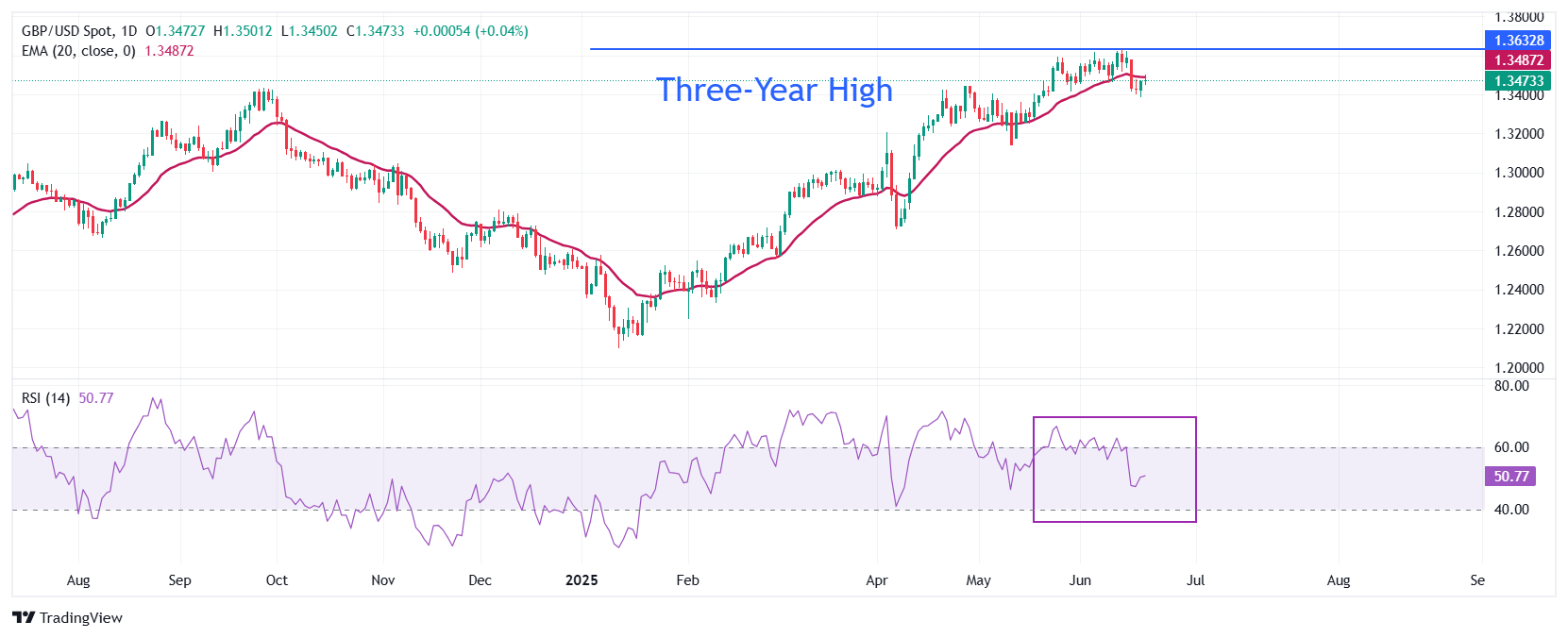
The Pound Sterling faces barricades around the psychological level of 1.3500 against the US Dollar, which coincides with the 20-day Exponential Moving Average (EMA), suggesting that the near-term trend is uncertain.
The 14-day Relative Strength Index (RSI) drops to near 50.00, indicating a sideways performance in the near term.
Looking down, the May 16 low around 1.3250 will act as a key support zone. On the upside, the three-year high around 1.3630 will act as a key barrier.
Economic Indicator
Retail Sales (MoM)
The Retail Sales data, released by the Office for National Statistics on a monthly basis, measures the volume of sales of goods by retailers in Great Britain directly to end customers. Changes in Retail Sales are widely followed as an indicator of consumer spending. Percent changes reflect the rate of changes in such sales, with the MoM reading comparing sales volumes in the reference month with the previous month. Generally, a high reading is seen as bullish for the Pound Sterling (GBP), while a low reading is seen as bearish.
Read more.Last release: Fri Jun 20, 2025 06:00
Frequency: Monthly
Actual: -2.7%
Consensus: -0.5%
Previous: 1.2%
Source: Office for National Statistics

 Copy Link
 Share on Facebook
 Share on X
 Share by Email