Gold remains confined in a range below $4,100; upside potential seems limited

- Gold remains on the defensive for the third straight day, though the downside seems cushioned.
- Reduced December Fed rate cut bets benefit the USD and weigh on the non-yielding commodity.
- Economic concerns and a softer risk tone could limit losses ahead of the delayed US macro data.
Gold (XAU/USD) lacks a firm intraday directional bias and seesaws between tepid gains/minor losses, below the $4,100 mark through the first half of the European session on Monday. A slew of influential FOMC members showed little conviction for reducing borrowing costs, prompting traders to scale back their expectations for another interest rate cut by the US Federal Reserve (Fed). This, in turn, helps revive the US Dollar (USD) demand at the start of a new week and turns out to be a key factor undermining the non-yielding yellow metal.
However, worries about the weakening economic momentum on the back of the longest-ever US government shutdown keep the door open for further policy easing by the Fed, which keeps a lid on the USD. This, along with a softer risk tone, assists the safe-haven Gold to hold above a one-week low, touched on Friday. Furthermore, traders now seem reluctant and opt to wait for the FOMC Minutes on Wednesday, which, along with the delayed US Nonfarm Payrolls (NFP) report on Thursday, should provide a fresh impetus to the USD and the commodity.
Daily Digest Market Movers: Gold traders seem non committed as modest USD strength and reduced Fed rate cut bets counters risk-off mood
- A growing number of Federal Reserve officials adopted a cautious stance and showed reluctance toward additional monetary policy easing. In fact, Kansas City Fed President Jeffrey Schmid said on Friday that inflation is too hot and that there is no room to be complacent on inflation expectations.
- Monetary policy is modestly restrictive, which is where it should be, and should lean against demand growth, Schmid added further. The probability for a 25 basis-point rate cut in December fell below 50% last week, which weighed on the non-yielding Gold for the second straight day on Friday.
- The US Dollar firmed slightly at the start of a new week as investors braced for the release of delayed US macro data for more clarity on the Fed's interest rate outlook. This, in turn, is seen as another factor that keeps the XAU/USD bulls on the defensive through the Asian session on Monday.
- The closely-watched US Nonfarm Payrolls report for October will be published on Thursday, following the release of FOMC Minutes on Wednesday. This, in turn, will play a key role in influencing the near-term USD price dynamics and providing some meaningful impetus to the precious metal.
- Investors seem convinced that the US economic data would show some weakness and a slowdown in the economy on the back of a prolonged US government shutdown and prompt the Fed to ease policy further. This, along with a softer risk tone, helps limit the downside for the safe-haven commodity.
Gold continues to show some resilience below 200-period SMA on H4; not out of the woods yet
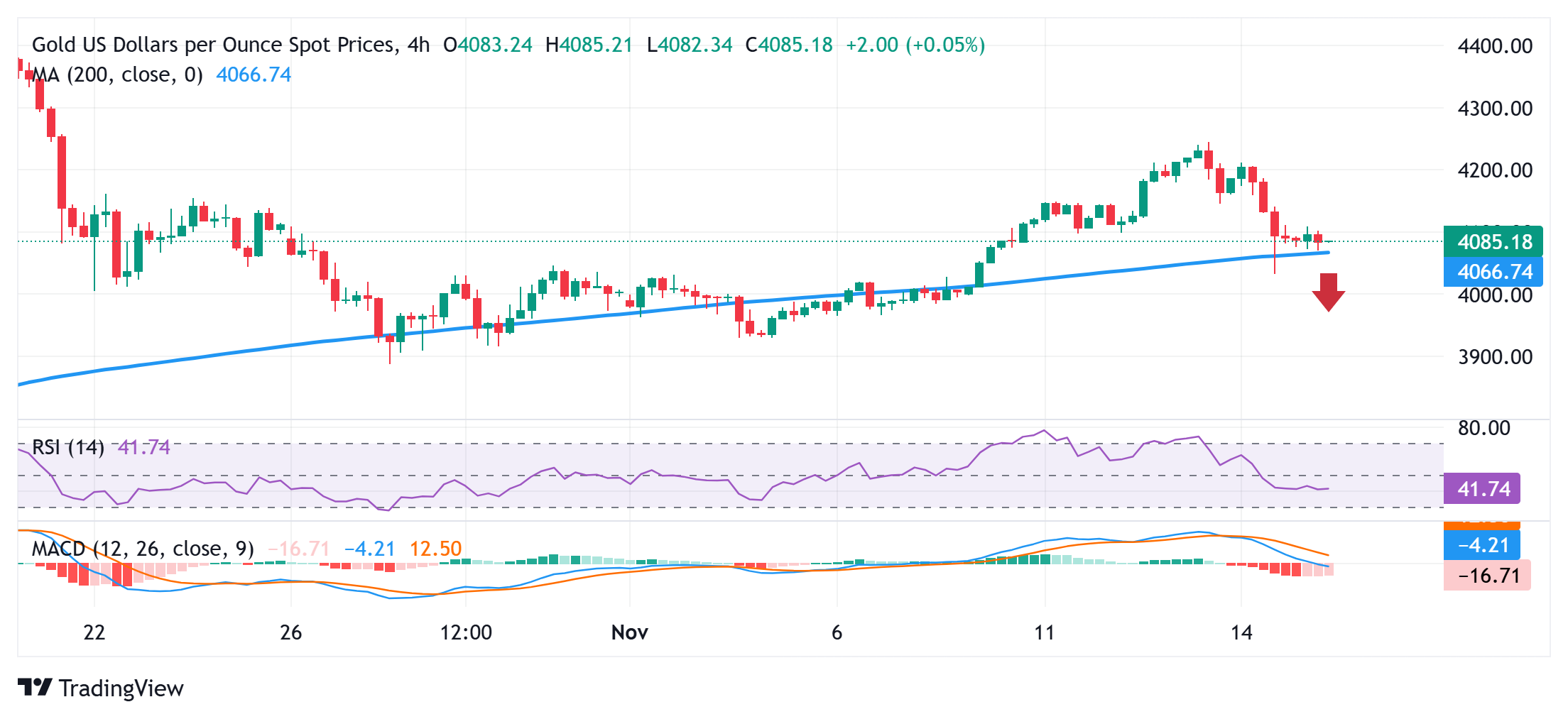
On Friday, the XAU/USD pair showed some resilience below the 20-period Simple Moving Average (SMA) on the 4-hour chart. The lack of any subsequent move up, however, warrants some caution for bullish traders. Moreover, negative oscillators on the said chart make it prudent to wait for sustained strength and acceptance above the $4,100 mark before positioning for further gains towards the $4,140-4,145 resistance. The momentum could extend further and allow the Gold price to make a fresh attempt towards conquering the $4,200 round figure.
On the flip side, weakness below the 200-period SMA on the 4-hour chart, currently around the $4,059 area, could find some support near Friday's swing low, around the $4,032 region. This is followed by the $4,000 psychological mark, which, if broken decisively, could make the Gold price vulnerable to accelerate the fall towards the $3,931 intermediate support en route to the $3,900 mark and late October swing low, around the $3,886 region.
(This story was corrected on November 17 at 07:44 GMT to say, in the first paragraph, that trader scale back their expectations for another interest rate cut, not hike.)
Economic Indicator
Nonfarm Payrolls
The Nonfarm Payrolls release presents the number of new jobs created in the US during the previous month in all non-agricultural businesses; it is released by the US Bureau of Labor Statistics (BLS). The monthly changes in payrolls can be extremely volatile. The number is also subject to strong reviews, which can also trigger volatility in the Forex board. Generally speaking, a high reading is seen as bullish for the US Dollar (USD), while a low reading is seen as bearish, although previous months' reviews and the Unemployment Rate are as relevant as the headline figure. The market's reaction, therefore, depends on how the market assesses all the data contained in the BLS report as a whole.
Read more.Next release: Thu Nov 20, 2025 13:30
Frequency: Monthly
Consensus: 50K
Previous: 22K
Source: US Bureau of Labor Statistics
America’s monthly jobs report is considered the most important economic indicator for forex traders. Released on the first Friday following the reported month, the change in the number of positions is closely correlated with the overall performance of the economy and is monitored by policymakers. Full employment is one of the Federal Reserve’s mandates and it considers developments in the labor market when setting its policies, thus impacting currencies. Despite several leading indicators shaping estimates, Nonfarm Payrolls tend to surprise markets and trigger substantial volatility. Actual figures beating the consensus tend to be USD bullish.

 Copy Link
 Share on Facebook
 Share on X
 Share by Email