Australian Dollar rises as RBA Minutes highlight persistent inflation

- Australian Dollar appreciates after the release of the Reserve Bank of Australia's Minutes of its December meeting.
- RBA Meeting Minutes showed growing doubt that policy remains restrictive as inflation pressures appear more persistent.
- The US Dollar faced headwinds as expectations grew that the Fed would continue easing policy.
The Australian Dollar (AUD) gains ground against the US Dollar (USD) on Tuesday, following the release of the Reserve Bank of Australia (RBA) Minutes of its December monetary policy meeting. Additionally, the AUD/USD pair appreciated as the US Dollar (USD) faced challenges amid growing expectations that the Federal Reserve will continue easing policy, reinforced by President Donald Trump’s calls for lower borrowing costs.
The RBA Meeting Minutes showed that board members signalled growing less confident that monetary policy remains restrictive, as evidence mounts that inflation pressures may prove more persistent than previously expected.
Policymakers also indicated that they would assess policy at future meetings, noting that G4 inflation data had been released ahead of the February meeting. They discussed whether a rate increase might be needed at some point in 2026 and felt that it would take a little longer to assess the persistence of inflation.
The ASX 30-Day Interbank Cash Rate Futures February 2026 contract was trading at 96.34 as of December 18, implying a 27% probability of a rate increase to 3.85% at the next RBA Board meeting.
US Dollar declines as precious metals rally amid rising geopolitical tensions
- The US Dollar Index (DXY), which measures the value of the US Dollar against six major currencies, is losing ground and trading around 98.20 at the time of writing. Traders await the US Gross Domestic Product (GDP) Annualized for the third quarter due on Tuesday. The US economy is estimated to have expanded at an annual rate of 3.2% in Q3. It would be a slowdown from the 3.8% growth in Q2.
- Federal Reserve Fed Member of the Board of Governors Stephen Miran said in an interview on Bloomberg TV on Monday that the last few months have seen data consistent with his view of the world and that he doesn’t see a recession in the near term. Miran said that failing to ease policy would raise recession risks, adding that the need to dissent for a 50 basis points diminishes over time as rates are reduced.
- The Greenback faces challenges as precious metals rally, supported by safe-haven demand amid rising geopolitical tensions between the US and Venezuela. US President Donald Trump said on Monday that the US would keep and maybe sell the oil it had seized off the coast of Venezuela in recent weeks. Trump added that the US would also keep the seized ships.
- The CME FedWatch tool shows a 80.0% probability of rates being held at the Fed’s January meeting, up from 75.6% a week earlier. Meanwhile, the likelihood of a 25-basis-point rate cut has fallen to 20.0% from 24.4% a week ago.
- Federal Reserve Bank of Cleveland President Beth Hammack said on Sunday that monetary policy is in a good position to pause and assess the effects of the 75-basis-point (bps) rate cuts on the economy during the first quarter, according to Bloomberg.
- The University of Michigan reported on Friday that the Consumer Sentiment Index was revised down to 52.9 in December from the previous reading of 53.3. Consumer Expectations Index fell to 54.6 from 55.0. Meanwhile, One-year Inflation Expectations were revised up to 4.2% from 4.1% in both the initial estimate and the prior month.
- The People’s Bank of China (PBOC), China's central bank, announced on Monday to leave its Loan Prime Rates (LPRs) unchanged. The one- and five-year LPRs were at 3.00% and 3.50%, respectively.
- Australia’s Consumer Inflation Expectations, which rose to 4.7% in December from November’s three-month low of 4.5%, support the Reserve Bank of Australia’s (RBA) hawkish stance.
Australian Dollar eyes three-month highs near 0.6700
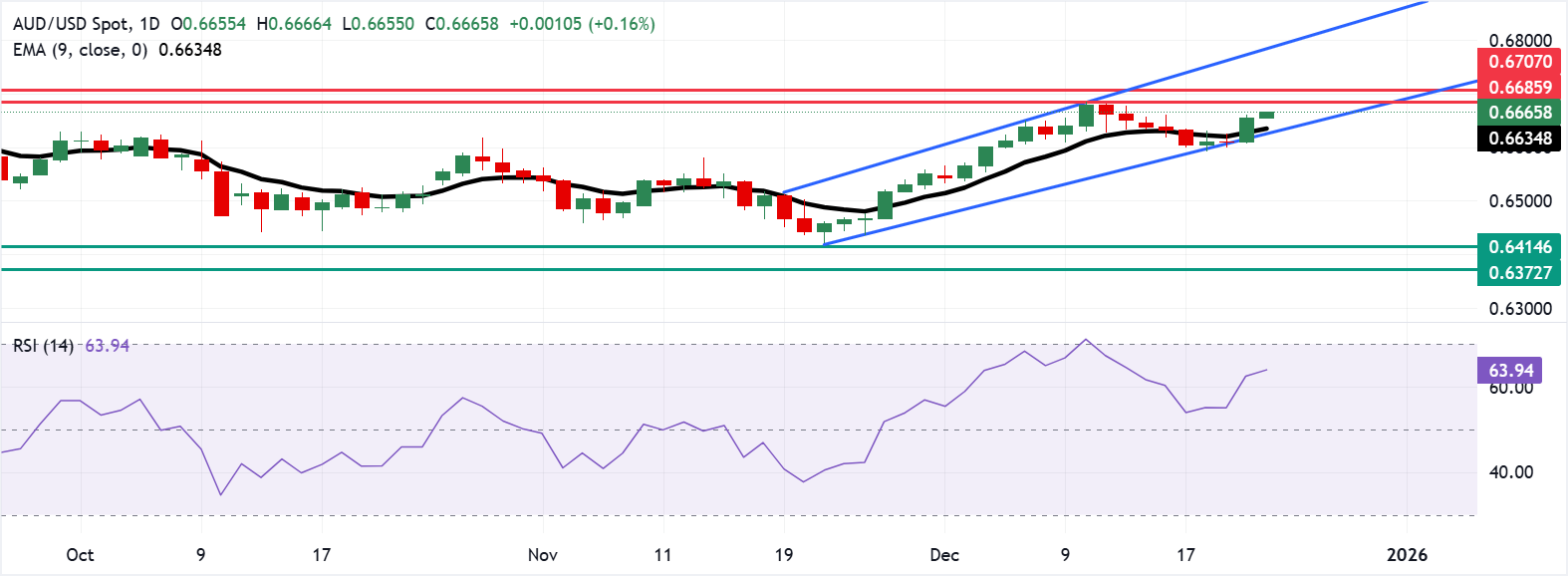
The AUD/USD pair is trading below 0.6660 on Tuesday. The technical analysis of the daily chart shows the pair is rising above the lower ascending channel boundary, indicating the strengthening of a bullish bias. The 14-day Relative Strength Index (RSI) stands at 63.34, reflecting bullish conditions and building momentum.
A successful break above the nine-day Exponential Moving Average (EMA) has improved the short-term price momentum and led the AUD/USD pair to target the three-month high at 0.6685 and then 0.6707, the highest since October 2024.
On the downside, the immediate support lies at 0.6633, aligned with the lower ascending channel boundary around 0.6630. A break below the channel would expose the six-month low near 0.6414, marked on August 21.
Australian Dollar Price Today
The table below shows the percentage change of Australian Dollar (AUD) against listed major currencies today. Australian Dollar was the strongest against the US Dollar.
| USD | EUR | GBP | JPY | CAD | AUD | NZD | CHF | |
|---|---|---|---|---|---|---|---|---|
| USD | -0.21% | -0.20% | -0.44% | -0.13% | -0.21% | -0.38% | -0.31% | |
| EUR | 0.21% | 0.00% | -0.22% | 0.09% | -0.00% | -0.17% | -0.11% | |
| GBP | 0.20% | -0.00% | -0.23% | 0.08% | -0.01% | -0.18% | -0.11% | |
| JPY | 0.44% | 0.22% | 0.23% | 0.30% | 0.24% | 0.02% | 0.14% | |
| CAD | 0.13% | -0.09% | -0.08% | -0.30% | -0.06% | -0.26% | -0.17% | |
| AUD | 0.21% | 0.00% | 0.00% | -0.24% | 0.06% | -0.17% | -0.10% | |
| NZD | 0.38% | 0.17% | 0.18% | -0.02% | 0.26% | 0.17% | 0.07% | |
| CHF | 0.31% | 0.11% | 0.11% | -0.14% | 0.17% | 0.10% | -0.07% |
The heat map shows percentage changes of major currencies against each other. The base currency is picked from the left column, while the quote currency is picked from the top row. For example, if you pick the Australian Dollar from the left column and move along the horizontal line to the US Dollar, the percentage change displayed in the box will represent AUD (base)/USD (quote).
Economic Indicator
RBA Meeting Minutes
The minutes of the Reserve Bank of Australia meetings are published two weeks after the interest rate decision. The minutes give a full account of the policy discussion, including differences of view. They also record the votes of the individual members of the Committee. Generally speaking, if the RBA is hawkish about the inflationary outlook for the economy, then the markets see a higher possibility of a rate increase, and that is positive for the AUD.
Read more.Last release: Tue Dec 23, 2025 00:30
Frequency: Weekly
Actual: -
Consensus: -
Previous: -
Source: Reserve Bank of Australia
The Reserve Bank of Australia (RBA) publishes the minutes of its monetary policy meeting two weeks after the interest rate decision is announced. It provides a detailed record of the discussions held between the RBA’s board members on monetary policy and economic conditions that influenced their decision on adjusting interest rates and/or bond buys, significantly impacting the AUD. The minutes also reveal considerations on international economic developments and the exchange rate value.

 Copy Link
 Share on Facebook
 Share on X
 Share by Email