Gold tests sub-$4,300 levels amid a broadly firmer USD; lacks follow-through selling

- Gold drifts lower on Tuesday as some follow-through USD buying prompts profit-taking.
- Fed rate cut bets and the US government shutdown might keep a lid on further USD gains.
- Trade uncertainties and geopolitical tensions should help limit losses for the XAU/USD pair.
Gold (XAU/USD) accelerates its intraday retracement slide from the vicinity of the all-time peak and slides below the $4,300 mark during the first half of the European session on Tuesday. The US Dollar (USD) is prolonging its short-term uptrend for the third straight day and turning out to be a key factor weighing on the commodity. Furthermore, a generally positive tone around the equity markets undermines the safe-haven precious metal and prompts bulls to take some profits off the table amid still overbought conditions.
Meanwhile, the USD move up lacks any obvious fundamental catalyst and seems limited amid the growing acceptance that the Federal Reserve (Fed) will lower borrowing costs two more times this year. This, in turn, could act as a tailwind for the non-yielding Gold. Furthermore, concerns that a prolonged US government shutdown could affect the economic performance might cap the USD. This, along with persistent trade-related uncertainties and geopolitical tensions, might help limit losses for the safe-haven XAU/USD.
Daily Digest Market Movers: Gold bulls remain on the sidelines amid sustained USD buying
- The US Dollar attracts some buyers for the third consecutive day and exerts some downward pressure on the Gold price during the Asian session on Tuesday. Moreover, the global risk sentiment remains well supported by signs of easing US-China trade tensions and turns out to be another factor undermining the safe-haven precious metal.
- US President Donald Trump said on Friday that a full-scale tariff on China would be unsustainable. Trump added on Sunday that said that both countries would strike a fantastic deal, though he warned that failure to reach an agreement could see China face potential tariffs of 155%. This keeps focus squarely on US-China trade talks next week.
- According to the CME Group's FedWatch Tool, traders have nearly fully priced in a 25-basis-points rate cut at each of the US Federal Reserve's policy meetings in October and in December. This might keep a lid on any meaningful USD appreciating move and continue to act as a tailwind for the non-yielding yellow metal amid economic risks.
- Investors seem worried that a prolonged US government closure would affect the economic performance. The Senate voted against reopening the US government for the 11th time on Monday, extending the shutdown to a third week as both sides remain deadlocked. Trump accused the opposition of blocking efforts to curb illegal immigration.
- Russian President Vladimir Putin reportedly reiterated his demand that Ukraine give up all of Donetsk Oblast as a condition for ending the war, and suggested that Russia would be willing to surrender parts of occupied southern Ukraine. Adding to this, Trump said on Sunday that the battle lines should be frozen where they currently stand.
- Ukrainian President Volodymyr Zelenskyy, however, has repeatedly rejected the idea of forfeiting the Donbas, or any other occupied ground, to Russia. This keeps geopolitical risks in play, which should further extend some support to the safe-haven precious metal and contribute to limiting any meaningful corrective pullback.
- Traders might also opt to wait for the release of the latest US consumer inflation figures on Friday, which might provide some cues about the Fed's rate-cut path. This, in turn, will play a key role in influencing the USD price dynamics and driving the XAU/USD pair ahead of the crucial two-day FOMC policy meeting starting next Tuesday.
Gold seems vulnerable following intraday breakdown below the $4,300 mark
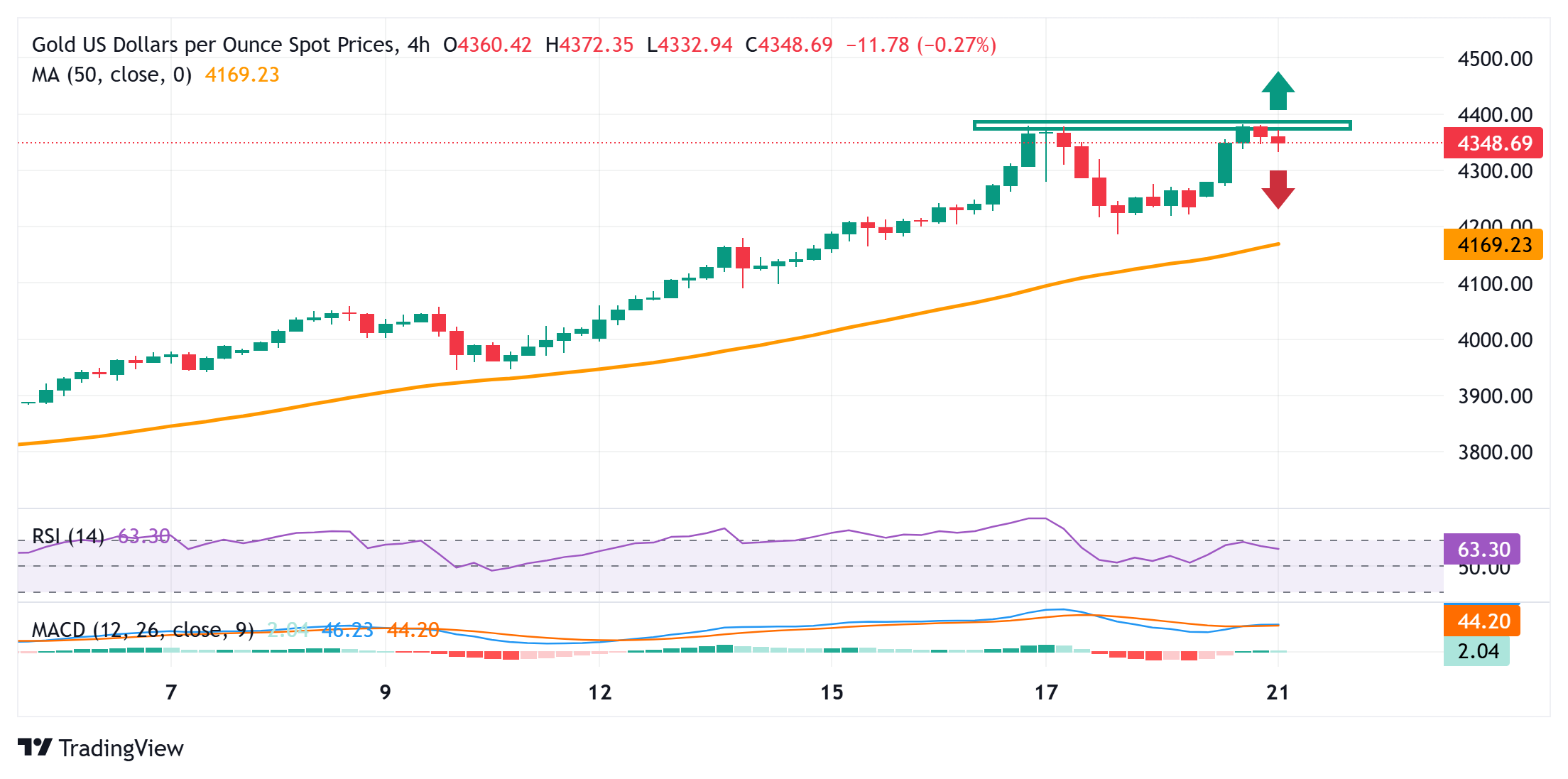
The precious metal has been facing difficulty in building on its recent well-established uptrend beyond the $4,375-4,380 zone. Given that the daily Relative Strength Index (RSI) is still flashing extremely overbought conditions, the repeated failures near the said region could be seen as the first sign of a bullish exhaustion. Any subsequent fall below the $4,330 area, however, is likely to attract some buyers and remain cushioned near the $4,300 mark. A convincing break below the latter might prompt some technical selling and make the Gold price vulnerable to accelerate the corrective fall towards the $4,240 intermediate support en route to the $4,210-4,200 region.
On the flip side, bulls might wait for a sustained move beyond the $4,375-4,380 region before placing fresh bets. A subsequent strength beyond the $4,400 round figure will mark a fresh breakout for the Gold price and pave the way for an extension of a well-established uptrend witnessed over the past two months or so.
US-China Trade War FAQs
Generally speaking, a trade war is an economic conflict between two or more countries due to extreme protectionism on one end. It implies the creation of trade barriers, such as tariffs, which result in counter-barriers, escalating import costs, and hence the cost of living.
An economic conflict between the United States (US) and China began early in 2018, when President Donald Trump set trade barriers on China, claiming unfair commercial practices and intellectual property theft from the Asian giant. China took retaliatory action, imposing tariffs on multiple US goods, such as automobiles and soybeans. Tensions escalated until the two countries signed the US-China Phase One trade deal in January 2020. The agreement required structural reforms and other changes to China’s economic and trade regime and pretended to restore stability and trust between the two nations. However, the Coronavirus pandemic took the focus out of the conflict. Yet, it is worth mentioning that President Joe Biden, who took office after Trump, kept tariffs in place and even added some additional levies.
The return of Donald Trump to the White House as the 47th US President has sparked a fresh wave of tensions between the two countries. During the 2024 election campaign, Trump pledged to impose 60% tariffs on China once he returned to office, which he did on January 20, 2025. With Trump back, the US-China trade war is meant to resume where it was left, with tit-for-tat policies affecting the global economic landscape amid disruptions in global supply chains, resulting in a reduction in spending, particularly investment, and directly feeding into the Consumer Price Index inflation.

 Copy Link
 Share on Facebook
 Share on X
 Share by Email