Why Bitcoin Is Going Down Today? BTC Price Falls 4 Days Straight and Targets 2025 Lows at $74K

Bitcoin (BTC) price fell to $85,266 today (Tuesday), December 16, 2025, declining 2.06% from the previous day and extending its losing streak to four consecutive sessions.
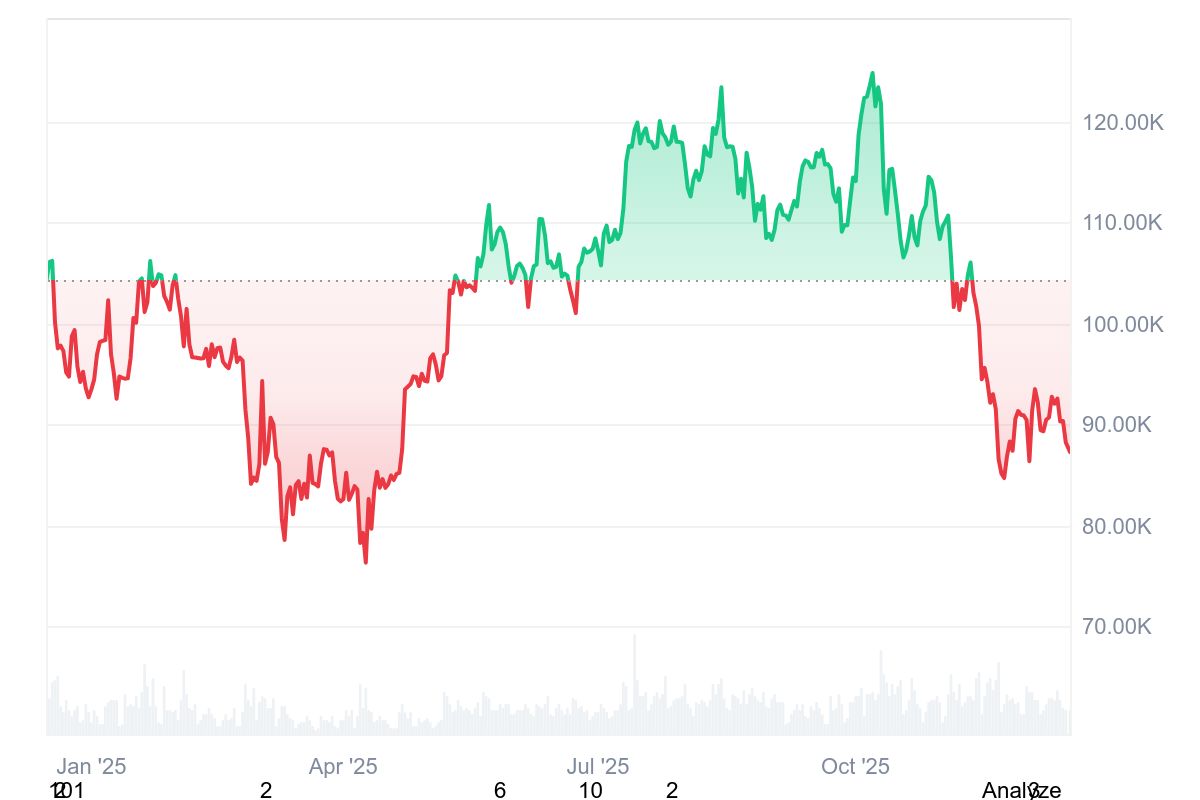
The world's largest cryptocurrency has dropped 30% from its October all-time high of $126,000 and now trades 18% below year-ago levels. This persistent weakness comes despite the Federal Reserve's third rate cut of 2025, as hawkish forward guidance and elevated correlation with correcting tech stocks override traditional liquidity narratives.
In this article, I answer the question of why Bitcoin is going down today by analyzing the BTC/USDT chart and presenting a current Bitcoin price outlook, drawing on my more than 10 years of experience as an analyst and trader.
Why Bitcoin Is Going Down Today?
At the moment, one Bitcoin is trading at 87,251, although the intraday lows are clearly lower. The price has posted four consecutive declining sessions and has moved decisively away from the 94,000 level that was still observed last week.
Federal Reserve Hawkish Pivot Undermines Rally
The Federal Reserve delivered its third consecutive 25-basis-point rate cut on December 10, bringing the target range to 3.50-3.75%, the lowest in three years. However, the central bank's signal of a potential easing pause in 2026 has triggered risk-off sentiment across digital assets, with Bitcoin proving particularly vulnerable.
"From a macro standpoint, crypto continues to trade in close alignment with traditional risk assets, particularly U.S. equities,” Joel Kruger, crypto strategist at LMAX, explains the macro headwinds. “Correlations remain elevated, reinforcing bitcoin's role as a proxy for broader risk sentiment. Interest rates, real yields, and the U.S. dollar remain key variables for crypto pricing."
Ten-year U.S. Treasury yields climbed to 4.2%, the highest since early September, creating unfavorable conditions for non-yielding assets like Bitcoin. The disconnect between rate cuts and rising yields reflects market concerns about persistent inflation and fiscal sustainability, pressuring growth assets across the board.
How Low Can BTC Price Go? Death Cross Pattern Signals Extended Decline
Bitcoin's technical structure has deteriorated significantly since mid-November when the dreaded "death cross" pattern emerged. On November 16, the 50-day moving average crossed below the 200-day moving average while Bitcoin traded around $93,000-$94,000. This bearish signal remains active as of December 16, with the 50 EMA currently residing near $94,000 and the 200 EMA above $103,000.
According to my technical analysis, the price action shows Bitcoin consolidating at local support between $84,000-$85,000, levels that coincide with lows from April, November, and December. Recent daily data confirms the weakness: Bitcoin fell from $92,494 on December 12 to $86,413 by December 16, testing multi-week lows.
Resistance has formed between $92,000-$94,000, representing May highs and the 61.8% Fibonacci retracement level where the 50 EMA acts as a ceiling. My chart structure suggests bears maintain control, with moving averages aligned in a bearish configuration supporting further downside.
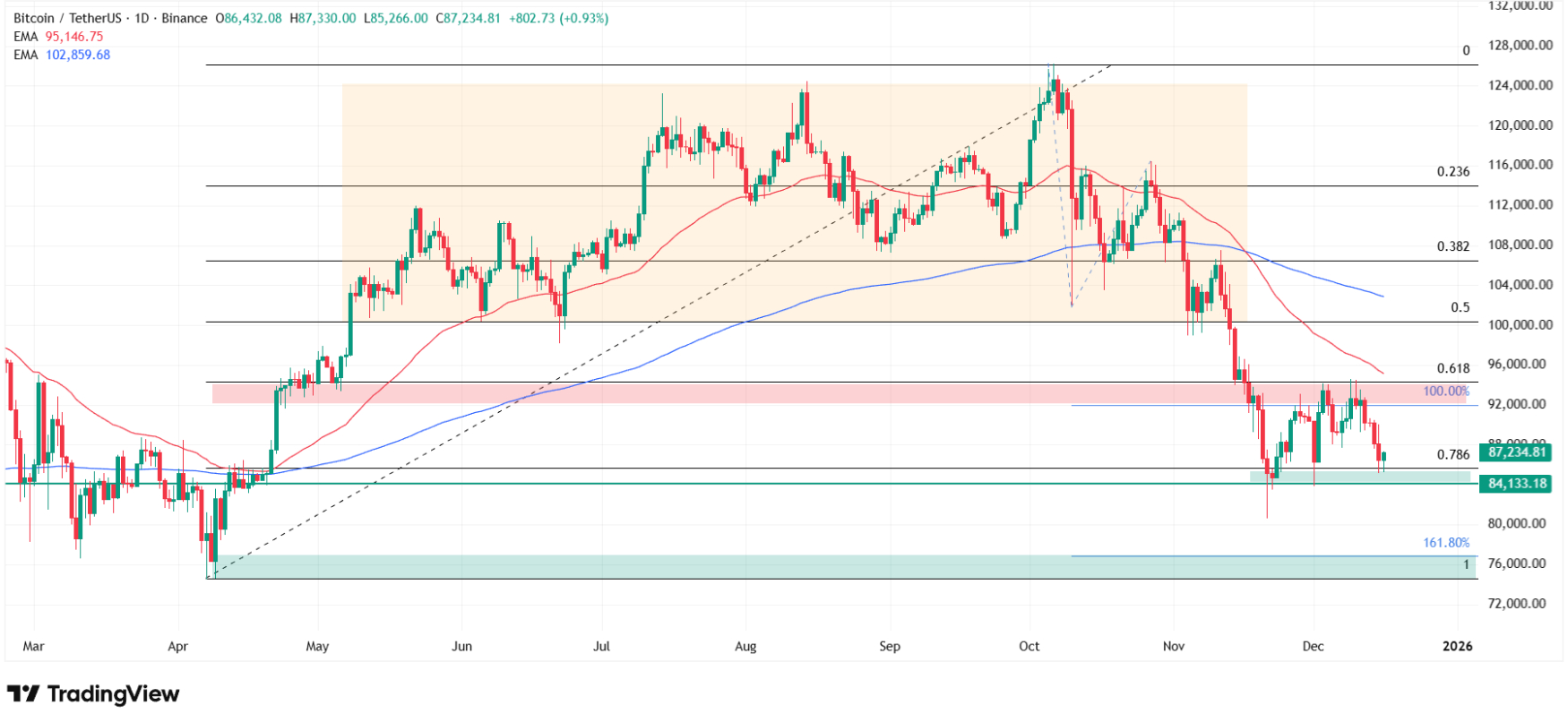
"Bitcoin is consolidating at multi-month lows, and the chart structure with moving averages suggests bears have the advantage, not bulls,” Arkadiusz Jóźwiak, Editor-in-Chief at Comparic.pl, reinforces the bearish outlook. “Although we could move in either direction from this consolidation, I lean more toward a downside breakout scenario moving toward April minimums."
BTC Targets $74,000: Capitulation Zone Ahead
Using Fibonacci extensions, the primary technical target sits at $74,000, representing the 161.8% extension of the recent corrective wave and coinciding with 2025 yearly lows. This level represents an expected full capitulation zone where weak hands exit and institutional reaccumulation begins.
Historical data shows Bitcoin testing progressively lower levels: $90,257 on December 14, $88,230 on December 15, and $86,413 on December 16. The critical support level to monitor is $80,000, a sustained break below this threshold would flip market structure decisively bearish and potentially trigger forced liquidations from institutional treasuries and ETF holders defending their balance sheets.
BTC Year-End Dynamics and Reversal Scenarios
Holiday season illiquidity may extend the current consolidation between $84,000-$94,000 before the next directional move materializes. The Bank of Japan meeting on December 19 represents a potential catalyst, as any hawkish tilt could trigger broader currency market volatility and additional pressure on risk assets.
Kruger from LMAX expects range-bound but volatile trading: "Looking ahead, markets are likely to remain reactive to macroeconomic data and policy commentary this week. Absent a clear crypto-specific catalyst, price action may remain range-bound but volatile. Overall, bitcoin and ethereum are expected to trade as high-beta expressions of global risk conditions."
Despite the bearish technical setup, my bearish scenario would be invalidated by a sustained breakout above $94,000, where the 61.8% Fibonacci retracement and 50 EMA converge. Ultimate bullish confidence returns only with a break above $103,000, where the 200 EMA resides, confirming the death cross reversal.
Changpeng "CZ" Zhao, former Binance CEO, offered perspective on market cycles via Twitter: "If you were ever jealous of people buying crypto on the cheap, and able to hold them through the cycles, think about what they did in moments like this.”
If you were ever jealous of people buying crypto on the cheap, and able to hold them through the cycles, think about what they did in moments like this.
— CZ 🔶 BNB (@cz_binance) December 16, 2025
FAQ: Bitcoin Price Analysis Questions
Why is Bitcoin falling today?
Bitcoin is falling due to the Federal Reserve's hawkish 2026 guidance despite December rate cuts, elevated correlation with correcting Nasdaq tech stocks, active death cross pattern since November 16, and capital rotation from crypto to gold as safe-haven preference intensifies. The 10-year Treasury yield at 4.2% creates unfavorable conditions for non-yielding digital assets.
How low can Bitcoin go in 2025?
Technical analysis using Fibonacci extensions identifies $74,000 as the primary target, representing the 161.8% extension and 2025 yearly lows where full capitulation and institutional reaccumulation is expected. Critical support sits at $80,000, a break below triggers bearish market structure flip. Current consolidation between $84,000-$85,000 represents April/November/December lows.
Will Bitcoin crash further?
The bearish scenario toward $74,000 remains probable while Bitcoin trades below $94,000 resistance and the death cross pattern stays active. Historical death cross patterns precede extended declines, though Bitcoin must fail to bounce within seven days of testing support to confirm another leg down. Sustained breakout above $94,000 (50 EMA, 61.8% Fibonacci) invalidates the bearish thesis.
What is Bitcoin price prediction for 2026?
Current technical setup suggests capitulation at $74,000 before institutional reaccumulation begins. Bullish reversal requires sustained breakout above $103,000 (200 EMA) to confirm death cross invalidation and trend change. Year-end holiday illiquidity may extend $84,000-$94,000 consolidation before next directional move.
When will Bitcoin recover?
Sustained breakout above $94,000 where the 50 EMA and 61.8% Fibonacci retracement converge negates the bearish scenario. Full bullish confidence returns above $103,000 (200 EMA), confirming death cross reversal. The Bank of Japan meeting December 19 could provide near-term catalyst for volatility in either direction.
Before you go, you can also check my previous Bitcoin price predictions:
[#highlighted-links#]

 Copy Link
 Share on Facebook
 Share on X
 Share by Email