Gold struggles to build on intraday move up as Fed's hawkish tilt underpins USD

- Gold attracts some di-buyers on Monday as Trump’s remarks revive safe-haven demand.
- The Fed’s hawkish stance continues to underpin the USD and might cap the commodity.
- Traders now look to the US ISM Manufacturing PMI and Fed speak for a fresh impetus.
Gold (XAU/USD) sticks to modest intraday gains through the first half of the European session on Monday, though it lacks follow-through and remains below the $4,050 level amid mixed cues. Comments from US President Donald Trump suggested that his administration may restrict the flow of cutting-edge artificial intelligence (AI) hardware to its strategic rival, China. This turns out to be a key factor that provides a modest lift to the safe-haven precious metal. Apart from this, concerns about economic risks stemming from a prolonged US government shutdown further underpin the commodity.
Meanwhile, the US Federal Reserve's (Fed) hawkish tilt assists the US Dollar (USD) to build on last week's strong gains and climb to a fresh high since early August. This, in turn, might hold back traders from placing aggressive bullish bets around the non-yielding Gold. Apart from this, the underlying bullish tone around the equity markets might contribute to capping the XAU/USD pair. Hence, it will be prudent to wait for a sustained move beyond the aforementioned hurdle before positioning for an extension of the recent recovery from sub-$3,900 levels, or an over three-week low, touched last Tuesday.
Daily Digest Market Movers: Gold benefits from safe-haven flows after Trump's comments
- US President Donald Trump told reporters aboard Air Force One on Sunday that Nvidia's advanced Blackwell chip for artificial intelligence would not be available to other people. This, to some extent, offsets the latest optimism fueled by the de-escalation of trade tensions between the US and China – the world's two largest economies – and provides a modest lift to the safe-haven Gold at the start of a new week.
- The US government shutdown enters Day 33 on Monday amid a deadlock in Congress on the Republican-backed funding bill. Trump again urged Republican senators to end the shutdown by abolishing the filibuster rule, an unprecedented move that GOP leaders have, so far, resisted. Nevertheless, concerns that a prolonged government closure could cause economic damage further underpin the precious metal.
- The US Federal Reserve lowered borrowing costs by 25 basis points for the second time this year last Wednesday and also said it would stop reducing the size of its balance sheet as soon as December, marking the end of its quantitative tightening. That said, Fed Chair Jerome Powell cautioned that another similarly-sized interest rate cut is far from a foregone conclusion at the next monetary policy meeting in December.
- Furthermore, a slew of influential FOMC members further pushed back against expectations for more policy easing by the end of this year. This, in turn, assists the US Dollar to preserve last week's strong gains and stand firm near its highest level since early August. Apart from this, the upbeat market mood could keep a lid on further appreciation for the non-yielding yellow metal and warrants caution for bullish traders.
- Traders now look forward to Monday's US economic docket, featuring the release of the ISM Manufacturing PMI later during the North American session. Apart from this, speeches from influential FOMC members will play a key role in driving the USD demand and providing a fresh impetus to the commodity.
Gold might struggle to make it through $4,045-4,050 pivotal resistance
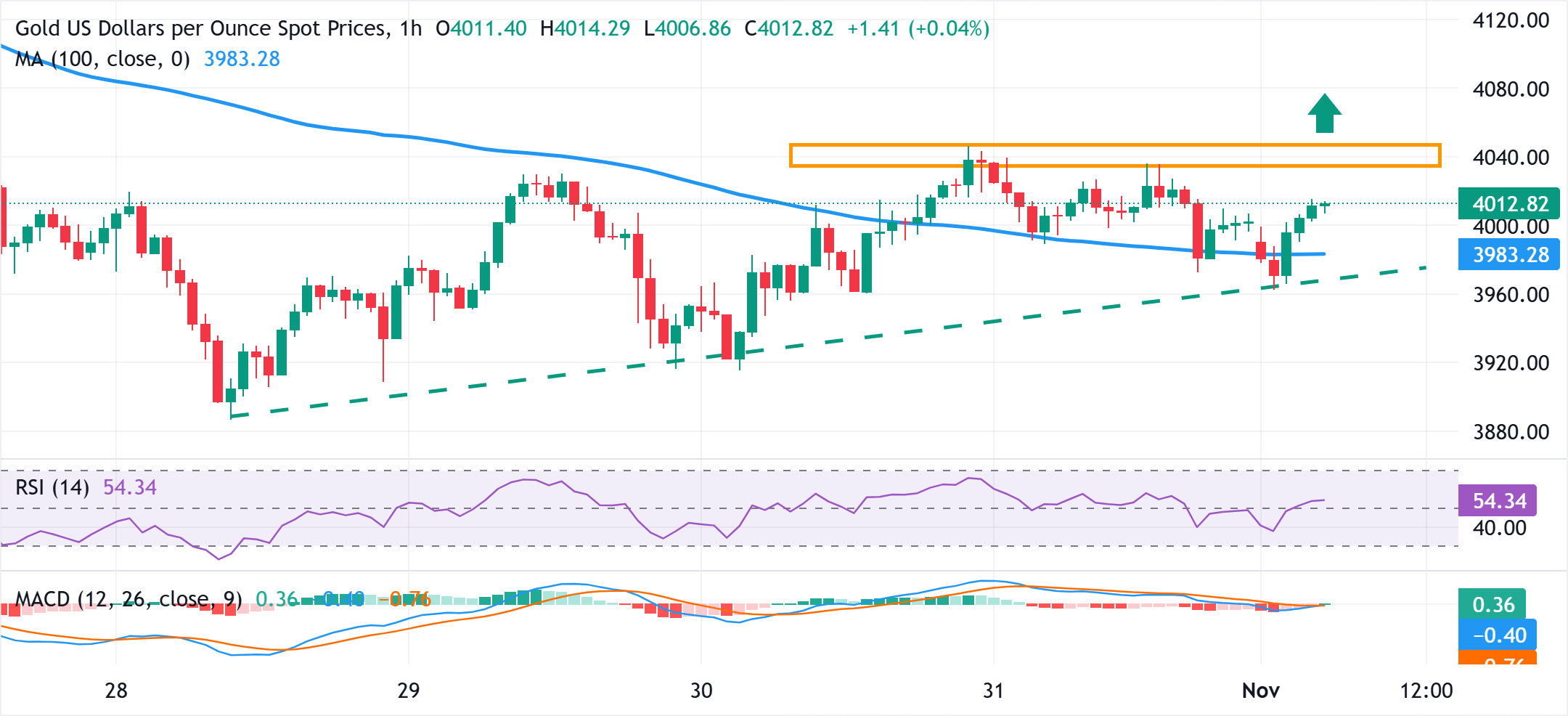
The XAU/USD pair showed some resilience below the 100-hour Simple Moving Average (SMA) during the Asian session. Moreover, oscillators on hourly/daily charts have again started gaining positive traction and back the case for additional gains. However, it will be prudent to wait for a sustained move beyond the $4,045-4,050 hurdle, above which the Gold price could climb to the $4,075 intermediate hurdle before aiming to reclaim the $4,100 mark.
On the flip side, the Asian session low, around the $3,963-3,962 region, now seems to protect the immediate downside ahead of the $3,917-3,916 region and the $3,900 round figure. Some follow-through selling below the $3,886 zone, or an over three-week low touched last Tuesday, could make the Gold price vulnerable to accelerate the fall towards the $3,850-3,845 zone en route to the $3,800 mark and the next relevant supports near the $3,765-3,760 zone.
Fed FAQs
Monetary policy in the US is shaped by the Federal Reserve (Fed). The Fed has two mandates: to achieve price stability and foster full employment. Its primary tool to achieve these goals is by adjusting interest rates. When prices are rising too quickly and inflation is above the Fed’s 2% target, it raises interest rates, increasing borrowing costs throughout the economy. This results in a stronger US Dollar (USD) as it makes the US a more attractive place for international investors to park their money. When inflation falls below 2% or the Unemployment Rate is too high, the Fed may lower interest rates to encourage borrowing, which weighs on the Greenback.
The Federal Reserve (Fed) holds eight policy meetings a year, where the Federal Open Market Committee (FOMC) assesses economic conditions and makes monetary policy decisions. The FOMC is attended by twelve Fed officials – the seven members of the Board of Governors, the president of the Federal Reserve Bank of New York, and four of the remaining eleven regional Reserve Bank presidents, who serve one-year terms on a rotating basis.
In extreme situations, the Federal Reserve may resort to a policy named Quantitative Easing (QE). QE is the process by which the Fed substantially increases the flow of credit in a stuck financial system. It is a non-standard policy measure used during crises or when inflation is extremely low. It was the Fed’s weapon of choice during the Great Financial Crisis in 2008. It involves the Fed printing more Dollars and using them to buy high grade bonds from financial institutions. QE usually weakens the US Dollar.
Quantitative tightening (QT) is the reverse process of QE, whereby the Federal Reserve stops buying bonds from financial institutions and does not reinvest the principal from the bonds it holds maturing, to purchase new bonds. It is usually positive for the value of the US Dollar.

 Copy Link
 Share on Facebook
 Share on X
 Share by Email