Gold remains below $4,250 barrier as traders await US PCE data for directional impetus

- Gold gains some positive traction on Friday, though it remains confined in the weekly range.
- Dovish Fed expectations continue to undermine the USD and lend support to the commodity.
- Bulls, however, might opt to wait for the US PCE Price Index before placing aggressive bets.
Gold (XAU/USD) sticks to its modest intraday gains through the first half of the European session on Friday, though it lacks bullish conviction and remains confined in the weekly range. The US Dollar (USD) struggles to capitalize on the previous day's bounce from the lowest level since late October and attracts fresh sellers amid dovish Federal Reserve (Fed) expectations. This, in turn, is seen as a key factor driving flows towards the non-yielding yellow metal.
Furthermore, the cautious market mood and persistent geopolitical uncertainties stemming from the protracted Russia-Ukraine war lend additional support to the safe-haven Gold. The XAU/USD bulls, however, seem reluctant and opt to wait for the release of the September Personal Consumption Expenditures (PCE) Price Index before placing fresh bets. The data would offer cues about the Fed's rate-cut path and provide a fresh impetus to the commodity.
Daily Digest Market Movers: Gold looks to US PCE Price Index for some meaningful impetus
- Global outplacement firm Challenger, Gray & Christmas said that planned job cuts declined 53%, to 71,321 in November, from 153,074 in the previous month, which was the highest for an October month since 2003. Separately, the US Labour Department reported that Initial Jobless Claims fell to 191K in the week ended November 29, marking the lowest level in more than three years.
- Despite the upbeat labor market reports, traders are still pricing in an over 85% probability that the US Federal Reserve will cut interest rates by 25 basis points at its upcoming policy meeting next week. This, in turn, fails to assist the US Dollar to build on Thursday's modest recovery move and continues to act as a tailwind for the non-yielding Gold through the Asian session on Friday.
- Russian President Vladimir Putin said on Thursday that some proposals in a US plan to end the war in Ukraine are unacceptable, suggesting that any deal is still some ways off. Furthermore, Putin warned again that Ukrainian troops must withdraw from the Donbas region or Russia will seize it. This keeps geopolitical risks in play and turns out to be another factor supporting the commodity.
- Market participants are now eyeing the September US Personal Consumption Expenditures (PCE) Price Index. The headline print is expected to show that annual inflation in the US edged higher to 2.8% from 2.7% in August. Meanwhile, the core PCE Price Index – which is seen as the Fed's preferred inflation gauge – is seen holding steady at the 2.9% YoY rate during the reported month.
- Nevertheless, the crucial data will be scrutinized closely for more cues about the Fed's future rate-cut path. This will drive the USD demand and provide a fresh directional impetus to the commodity. In the meantime, the mixed fundamental backdrop, warrants caution before placing aggressive bets around the XAU/USD pair, which seems poised to post modest weekly losses.
Gold needs to breakout through the weekly range before the next leg of a directional move
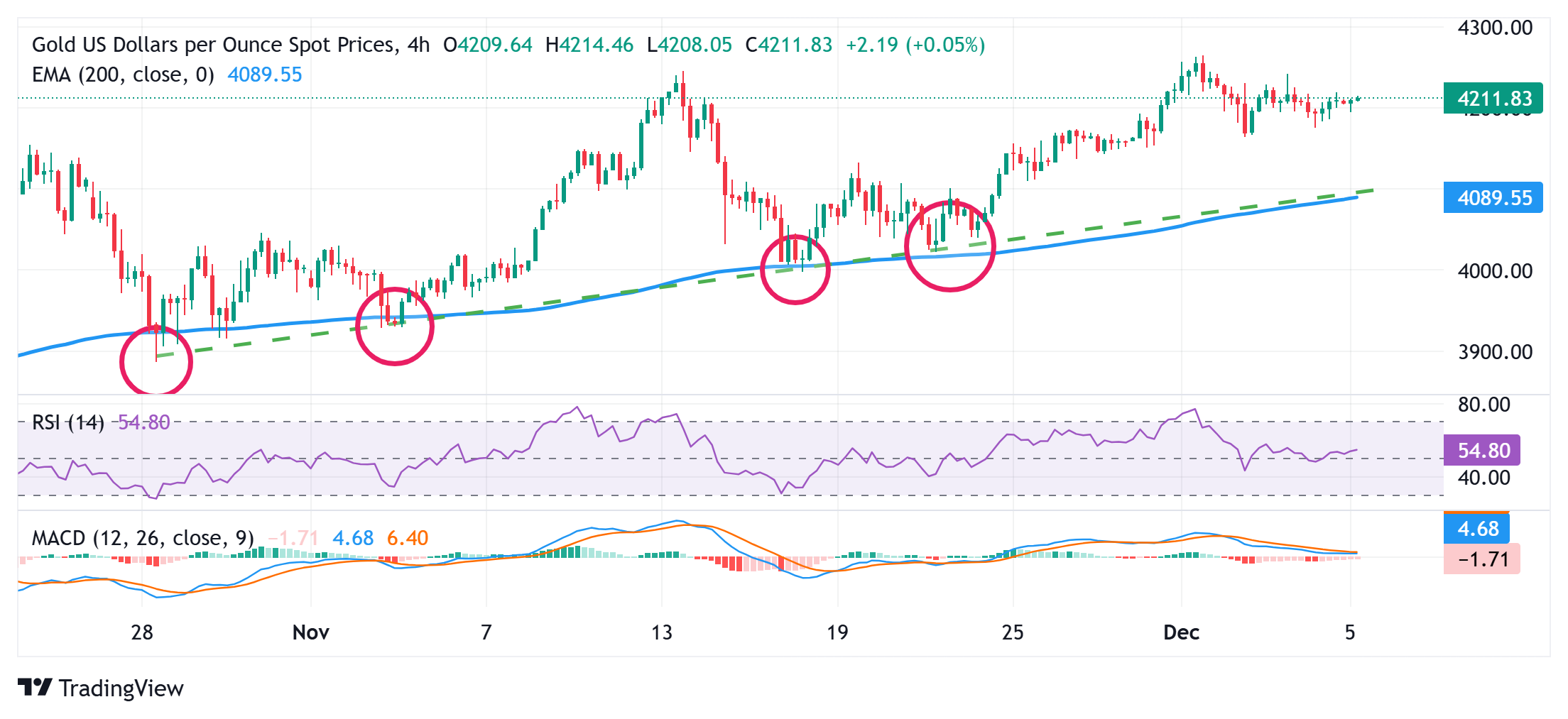
Any upside momentum might continue to face some resistance near the $4,245-4,250 region amid mixed technical oscillators on hourly/daily charts. The next relevant hurdle is pegged near the $4,277-4,278 area, above which the Gold price could aim to reclaim the $4,300 round figure. A sustained strength beyond the latter will be seen as a key trigger for the XAU/USD bulls and pave the way for additional near-term gains.
On the flip side, dips towards the weekly low, around the $4,164-4,163 region, might still be seen as a buying opportunity and remain limited. A convincing break below, however, might prompt technical selling and make the Gold price vulnerable to test the $4,100-4,090 confluence. The latter comprises the 200-period Exponential Moving Average (EMA) on the 4-hour chart and an ascending trend-line extending from late October, which in turn, should act as a strong base for the XAU/USD pair.
Economic Indicator
Core Personal Consumption Expenditures - Price Index (YoY)
The Core Personal Consumption Expenditures (PCE), released by the US Bureau of Economic Analysis on a monthly basis, measures the changes in the prices of goods and services purchased by consumers in the United States (US). The PCE Price Index is also the Federal Reserve’s (Fed) preferred gauge of inflation. The YoY reading compares the prices of goods in the reference month to the same month a year earlier. The core reading excludes the so-called more volatile food and energy components to give a more accurate measurement of price pressures." Generally, a high reading is bullish for the US Dollar (USD), while a low reading is bearish.
Read more.Next release: Fri Dec 05, 2025 13:30
Frequency: Monthly
Consensus: 2.9%
Previous: 2.9%
Source: US Bureau of Economic Analysis
After publishing the GDP report, the US Bureau of Economic Analysis releases the Personal Consumption Expenditures (PCE) Price Index data alongside the monthly changes in Personal Spending and Personal Income. FOMC policymakers use the annual Core PCE Price Index, which excludes volatile food and energy prices, as their primary gauge of inflation. A stronger-than-expected reading could help the USD outperform its rivals as it would hint at a possible hawkish shift in the Fed’s forward guidance and vice versa.

 Copy Link
 Share on Facebook
 Share on X
 Share by Email