Gold drops to multi-day low amid reduced Fed rate cut bets; $4,000 holds the key

- Gold remains on the defensive as mostly upbeat US NFP report tempers Fed rate cut bets.
- US economic concerns keep the USD below a multi-month top and could support XAU/USD.
- A weaker risk tone warrants caution before placing bearish bets around the precious metal.
Gold (XAU/USD) drops to a multi-day low during the first half of the European session, though it lacks follow-through selling and, so far, has managed to hold above the $4,000 psychological mark amid mixed cues. Chances for another interest rate cut by the Federal Reserve (Fed) in December declined further following the delayed release of the September US Nonfarm Payrolls (NFP) report on Thursday. This, in turn, is seen as a key factor driving flows away from the non-yielding yellow metal.
The US Dollar (USD), however, struggles to lure buyers and trades with a mild negative bias below its highest level since late May, touched on Thursday, which could offer some support to the Gold. Apart from this, concerns about the weakening economic momentum amid the longest-ever US government shutdown and persistent geopolitical uncertainties, fueled by the protracted Russia-Ukraine war, should contribute to limiting any further depreciation for the safe-haven precious metal.
Daily Digest Market Movers: Gold is pressured by reduced bets for a Fed rate cut in December
- The US Bureau of Labor Statistics published the closely-watched Nonfarm Payrolls report on Thursday, which showed that the economy added 119,000 new jobs in September. The reading followed the 4,000 decrease (revised from +22,000) recorded in August and surpassed the market expectation of 50,000.
- Additional details revealed that annual wage inflation, as measured by the change in the Average Hourly Earnings, held steady at 3.8% YoY, compared to the estimates of 3.7%. This helped offset an uptick in the Unemployment Rate from 4.3% to 4.4% and validated less dovish Federal Reserve expectations.
- This comes on top of less dovish October FOMC minutes on Wednesday, which showed that members remained divided about how to proceed. According to the CME Group's FedWatch Tool, the probability of another interest rate cut by the US Federal Reserve in December has now dropped to around 35%.
- This has been a key factor behind the US Dollar's recent move up to its highest level since late May and continues to act as a headwind for the non-yielding Gold during the Asian session on Friday. However, the fragile global risk sentiment could help limit the downside for the safe-haven precious metal.
- Traders now look forward to the release of flash US PMIs and the revised University of Michigan Consumer Sentiment Index. Furthermore, speeches by influential FOMC members will be scrutinized for more cues about the rate-cut path should provide a fresh impetus to the USD and the XAU/USD pair.
- Ukraine's President Volodymyr Zelenskyy said that he will negotiate with President Donald Trump on the US-backed 28-point peace plan that called on Ukraine to make painful concessions in order to end the Russian invasion. This keeps geopolitical risks in play and could further support the commodity.
Gold approaches $4,020 confluence support amid mixed technical setup
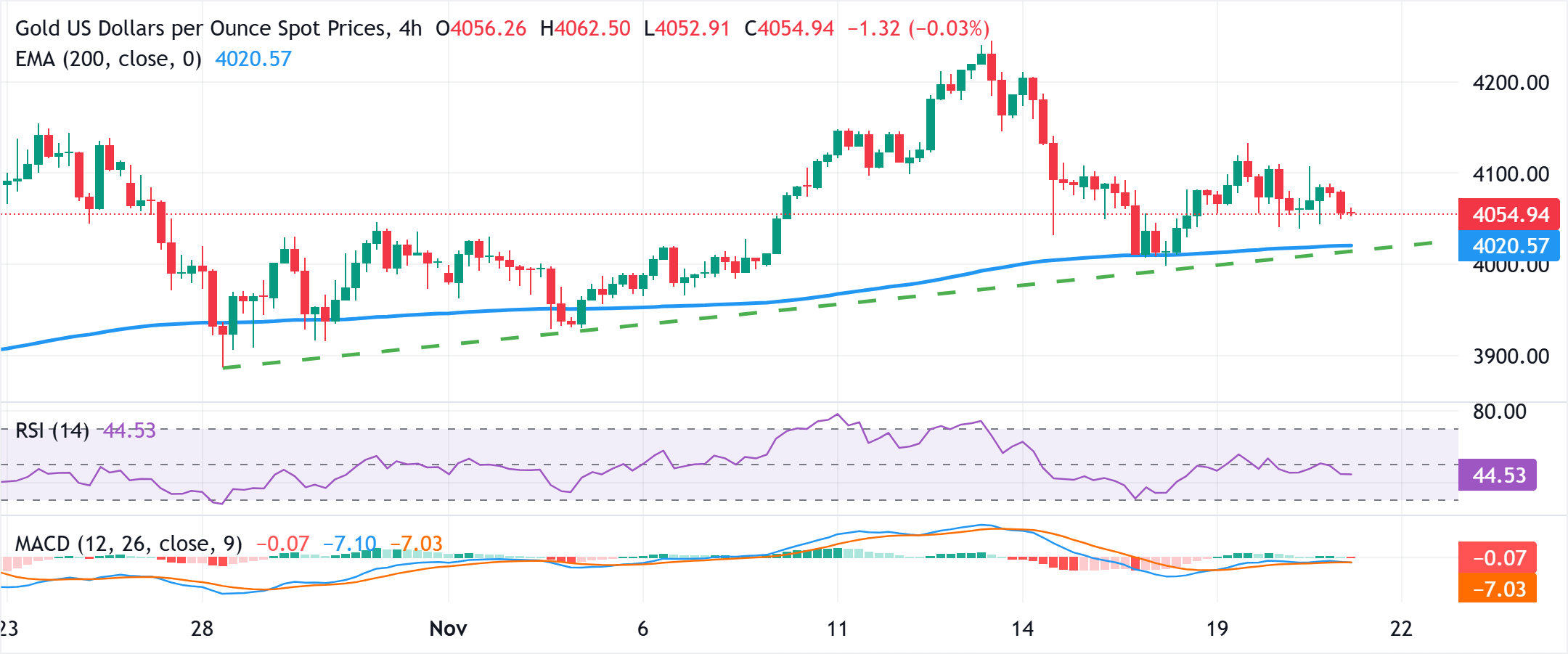
The precious metal is holding above a nearly one-month-old ascending trend-line support, currently pegged near the $4,020 region. The said area now coincides with the 200-period Exponential Moving Average (EMA) and should act as a key pivotal point. A convincing break below could make the Gold price vulnerable to weaken further below the $4,000 psychological mark and accelerate the slide towards the $3,931 support. The downward trajectory could extend further towards retesting the late October swing low, around the $3,886 region.
On the flip side, bulls need to wait for sustained strength and acceptance above the $4,100 mark before placing fresh bets. The subsequent strength could lift the Gold price to the next relevant hurdle near the $4,152-4,155 region, and the momentum could extend further towards reclaiming the $4,200 round-figure mark.
Risk sentiment FAQs
In the world of financial jargon the two widely used terms “risk-on” and “risk off'' refer to the level of risk that investors are willing to stomach during the period referenced. In a “risk-on” market, investors are optimistic about the future and more willing to buy risky assets. In a “risk-off” market investors start to ‘play it safe’ because they are worried about the future, and therefore buy less risky assets that are more certain of bringing a return, even if it is relatively modest.
Typically, during periods of “risk-on”, stock markets will rise, most commodities – except Gold – will also gain in value, since they benefit from a positive growth outlook. The currencies of nations that are heavy commodity exporters strengthen because of increased demand, and Cryptocurrencies rise. In a “risk-off” market, Bonds go up – especially major government Bonds – Gold shines, and safe-haven currencies such as the Japanese Yen, Swiss Franc and US Dollar all benefit.
The Australian Dollar (AUD), the Canadian Dollar (CAD), the New Zealand Dollar (NZD) and minor FX like the Ruble (RUB) and the South African Rand (ZAR), all tend to rise in markets that are “risk-on”. This is because the economies of these currencies are heavily reliant on commodity exports for growth, and commodities tend to rise in price during risk-on periods. This is because investors foresee greater demand for raw materials in the future due to heightened economic activity.
The major currencies that tend to rise during periods of “risk-off” are the US Dollar (USD), the Japanese Yen (JPY) and the Swiss Franc (CHF). The US Dollar, because it is the world’s reserve currency, and because in times of crisis investors buy US government debt, which is seen as safe because the largest economy in the world is unlikely to default. The Yen, from increased demand for Japanese government bonds, because a high proportion are held by domestic investors who are unlikely to dump them – even in a crisis. The Swiss Franc, because strict Swiss banking laws offer investors enhanced capital protection.

 Copy Link
 Share on Facebook
 Share on X
 Share by Email