EUR/USD crawls higher as the US Dollar softens amid a moderate risk appetite

- The ECB shows optimism about the economic outlook, but with tariff uncertainty looming.
- Trump escalated tensions with the EU, lifting the tariff baseline to 15%-20%.
- Technically, the EUR/USD remains within the bearish channel, with key resistance at 1.1655-1.1665.
The EUR/USD pair is showing moderate gains in the early European morning session on Monday as the US Dollar loses ground, weighed by a mild risk appetite and lower US Treasury yields.. A European Central Bank, (ECB) survey on finance observes an optimistic view on the economy among European businesses but warns about trade uncertainty.
The Euro trades around 1.1645 at the time of writing, and extends gains from last week's lows at 1.1555. The broader Euro-Dollar (USD) trend, however, remains bearish after a two-week decline, with price action still moving within a descending channel.
In the absence of relevant macroeconomic releases on Monday, the risk sentiment is driving the Euro higher and weighing on the US Dollar. US Treasury yields are accelerating their reversal from last week highs, with the yield of the benchmark 10-year note retreating to 10-day lows below 4.40, increasing negative pressure on the USD.
Tariff uncertainty, however, is keeping Euro bulls on the leash. Negotiations between Washington and the European Union (EU) have been underway for several weeks already, with no news to report so far. The US Commerce Secretary, Howard Lutnick, affirmed on Sunday that he is confident of reaching a deal. However, US President Trump warned that the August 1 deadline is firm, and the EU is already preparing retaliatory measures in case the talks end without an agreement.
The highlight of the week will be the European Central Bank's (ECB) monetary policy decision due on Thursday. The bank will most likely leave interest rates unchanged, but President Lagarde's comments on the economic outlook and the potential impact of tariffs will determine the Euro's near-term direction.
In the US, investors will keep an eye on corporate earnings. Tech megacaps Alphabet (GOOG) and Tesla (TSLA) will release their respective reports later this week, together with other firms like Lockheed Martin (LMT) and General Dynamics (GD), which might show increasing revenues boosted by higher defence spending.
Euro PRICE Today
The table below shows the percentage change of Euro (EUR) against listed major currencies today. Euro was the strongest against the US Dollar.
| USD | EUR | GBP | JPY | CAD | AUD | NZD | CHF | |
|---|---|---|---|---|---|---|---|---|
| USD | -0.15% | -0.30% | -0.15% | 0.01% | -0.02% | 0.13% | -0.17% | |
| EUR | 0.15% | -0.08% | 0.03% | 0.14% | 0.08% | 0.09% | -0.07% | |
| GBP | 0.30% | 0.08% | -0.14% | 0.27% | 0.19% | 0.38% | 0.21% | |
| JPY | 0.15% | -0.03% | 0.14% | 0.17% | 0.16% | 0.22% | 0.14% | |
| CAD | -0.01% | -0.14% | -0.27% | -0.17% | 0.03% | 0.11% | -0.23% | |
| AUD | 0.02% | -0.08% | -0.19% | -0.16% | -0.03% | 0.08% | -0.02% | |
| NZD | -0.13% | -0.09% | -0.38% | -0.22% | -0.11% | -0.08% | -0.18% | |
| CHF | 0.17% | 0.07% | -0.21% | -0.14% | 0.23% | 0.02% | 0.18% |
The heat map shows percentage changes of major currencies against each other. The base currency is picked from the left column, while the quote currency is picked from the top row. For example, if you pick the Euro from the left column and move along the horizontal line to the US Dollar, the percentage change displayed in the box will represent EUR (base)/USD (quote).
Daily digest market movers: Tariff concerns likely to weigh on the Euro
- Euro rallies are likely to remain limited this week, unless the EU negotiators announce a trade deal with the US. President Trump escalated tensions with the bloc, pushing for a minimum 15% to 20% tariff baseline, while the European Union (EU) is studying answering with tariffs higher than 10% on US products, even if a deal is struck.
- On the other hand, investors remain concerned that the impact of tariffs on the US economy might be akin to that of the Smoot-Hawley Act of 1930, which led to the Great Depression. The US Dollar has been trading higher over the last weeks, but it might start losing ground as the August 1 deadline approaches.
- The Wall Street Journal reported earlier on Monday that the US Treasury Secretary, Scott Bessent, urged President Trump to avoid ousting the chairman of the Federal Reserve (Fed), Jerome Powell, as it would create unnecessary turmoil and damage the economy.
- On Friday, the US Michigan Consumer Sentiment Index improved to 61.8 from 60.7 in the previous month, and slightly above the 61.5 forecasted by the analysts. These figures come in line with the strong employment and consumption data seen previously on the week, which contributed to supporting the US Dollar's recovery last week. Consumers' inflation expectations, also measured by the Michigan survey, declined significantly.
EUR/USD eyes an important resistance area at 1.1665
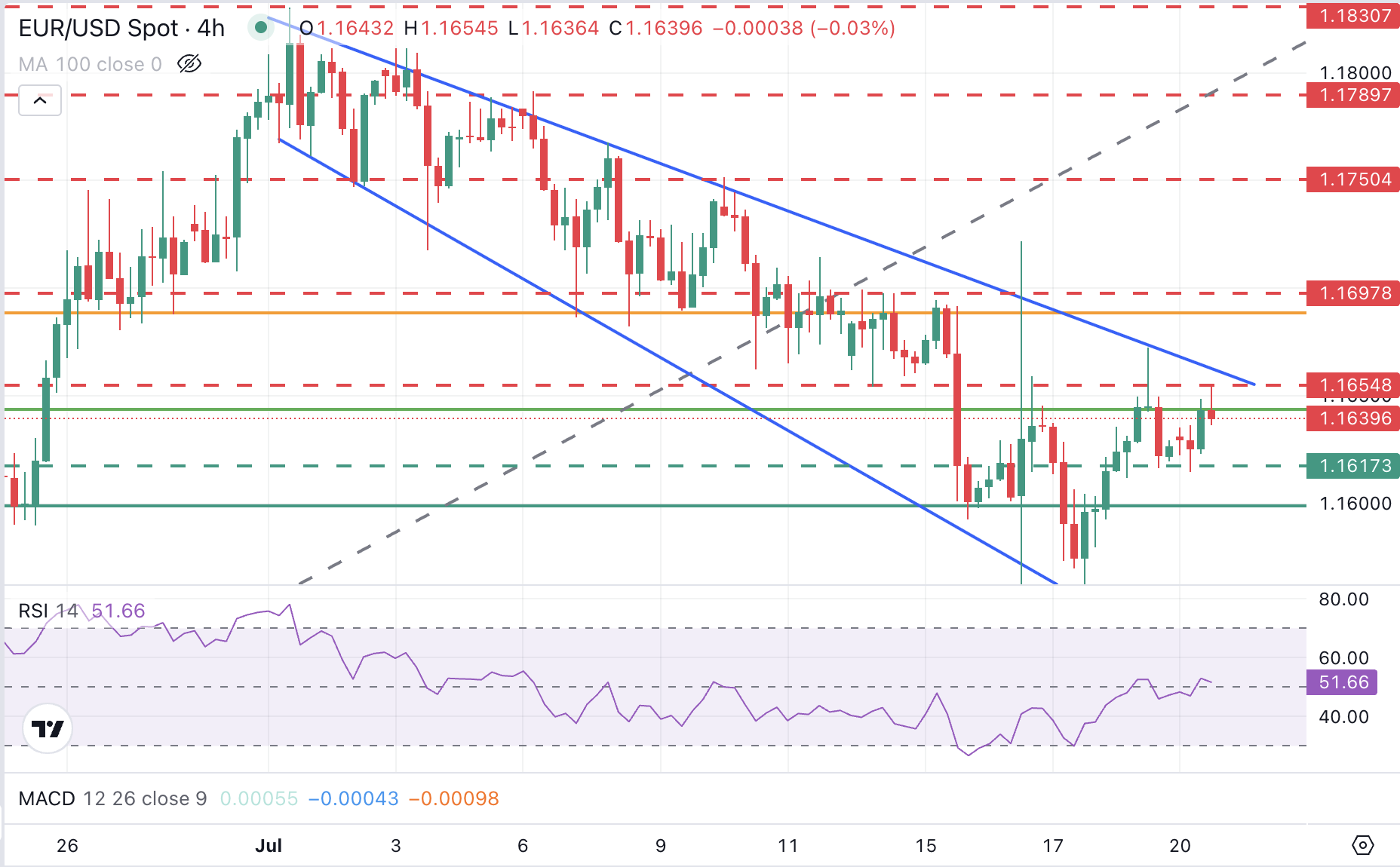
EUR/USD extends Friday's gains on Monday, but maintains the broader bearish trend intact so far. Price action remains contained within an expanding wedge since July 1, a pattern that highlights an emotional market, often seen after significant tops.
Technical indicators are pointing higher. But the pair should break above the previous support level at 1.1655 (July 14 low) and the channel's top at 1.1665 to confirm a trend shift. Next, the July 14 and 15 highs right below 1.1700 come into sight.
On the downside, immediate support is at the 1.1615 intra-day low, ahead of the July 17 low at 1.1555 and the 78.6% Fibonacci retracement of the late June bullish run at 1.1535.
Risk sentiment FAQs
In the world of financial jargon the two widely used terms “risk-on” and “risk off'' refer to the level of risk that investors are willing to stomach during the period referenced. In a “risk-on” market, investors are optimistic about the future and more willing to buy risky assets. In a “risk-off” market investors start to ‘play it safe’ because they are worried about the future, and therefore buy less risky assets that are more certain of bringing a return, even if it is relatively modest.
Typically, during periods of “risk-on”, stock markets will rise, most commodities – except Gold – will also gain in value, since they benefit from a positive growth outlook. The currencies of nations that are heavy commodity exporters strengthen because of increased demand, and Cryptocurrencies rise. In a “risk-off” market, Bonds go up – especially major government Bonds – Gold shines, and safe-haven currencies such as the Japanese Yen, Swiss Franc and US Dollar all benefit.
The Australian Dollar (AUD), the Canadian Dollar (CAD), the New Zealand Dollar (NZD) and minor FX like the Ruble (RUB) and the South African Rand (ZAR), all tend to rise in markets that are “risk-on”. This is because the economies of these currencies are heavily reliant on commodity exports for growth, and commodities tend to rise in price during risk-on periods. This is because investors foresee greater demand for raw materials in the future due to heightened economic activity.
The major currencies that tend to rise during periods of “risk-off” are the US Dollar (USD), the Japanese Yen (JPY) and the Swiss Franc (CHF). The US Dollar, because it is the world’s reserve currency, and because in times of crisis investors buy US government debt, which is seen as safe because the largest economy in the world is unlikely to default. The Yen, from increased demand for Japanese government bonds, because a high proportion are held by domestic investors who are unlikely to dump them – even in a crisis. The Swiss Franc, because strict Swiss banking laws offer investors enhanced capital protection.

 Copy Link
 Share on Facebook
 Share on X
 Share by Email