Gold pares modest intraday losses; upside seems limited amid a broadly firmer USD

- Gold struggles to capitalize on the overnight gains amid a mixed fundamental backdrop.
- The Fed’s hawkish stance continues to underpin the USD and weighs on the commodity.
- The US-China trade optimism contributes to capping the upside for the XAU/USD pair.
Gold (XAU/USD) recovers slightly from the daily low, though it retains intraday negative bias through the early European session as the US Dollar (USD) stands firm near a three-month top amid the Federal Reserve's (Fed) hawkish tilt. In fact, the US central bank pushed back against market expectations for another interest rate cut in December, which, in turn, is seen as a key factor that continues to undermine the non-yielding yellow metal.
Apart from this, the latest optimism over a de-escalation of trade tensions between the US and China – the world's two largest economies – further undermines the safe-haven Gold. However, concerns about economic risks stemming from a prolonged US government shutdown and geopolitical uncertainties act as a tailwind for the bullion. Nevertheless, the XAU/USD pair remains on track to end on a positive note for the third consecutive month.
Daily Digest Market Movers: Gold struggles to lure buyers as reduced Fed rate cut bets boost USD
- The US Dollar holds steady near its highest level since early August, touched on Thursday amid the US Federal Reserve's hawkish tilt, and exerts some pressure on the Gold price during the Asian session on Friday. In fact, Fed Chair Jerome Powell said that a further reduction in the policy rate at the December meeting is not a foregone conclusion.
- A high stakes meeting between US President Donald Trump and his Chinese counterpart Xi Jinping ended on a positive note. The US agreed to cut down tariffs against Chinese goods in exchange for China resuming US soybean purchases and keeping rare earths exports flowing. The optimism turns out to be another factor undermining the commodity.
- The US government shutdown has now entered its fifth week amid a deadlock in Congress on the Republican-backed funding bill, fueling economic concerns. This might hold back the USD bulls from placing aggressive bets, which, along with persistent geopolitical risk, could offer some support to the safe-haven precious metal and help limit further losses.
- Trump said on Thursday that he had ordered the US military to resume nuclear testing immediately. In response, Russia said that if the US resumes nuclear weapons testing it will do so too, sparking fears about a further escalation of the conflict. This, in turn, warrants some caution before positioning for any further depreciating move for the XAU/USD pair.
- In the absence of any relevant market moving economic releases due to the US government closure, traders will scrutinize comments from influential FOMC members for cues about the future rate-cut path. This will drive the USD demand and provide some impetus to the commodity, which remains on track to register gains for the third straight month.
Gold needs to surpass $4,050 pivotal resistance to back the case for any further appreciation
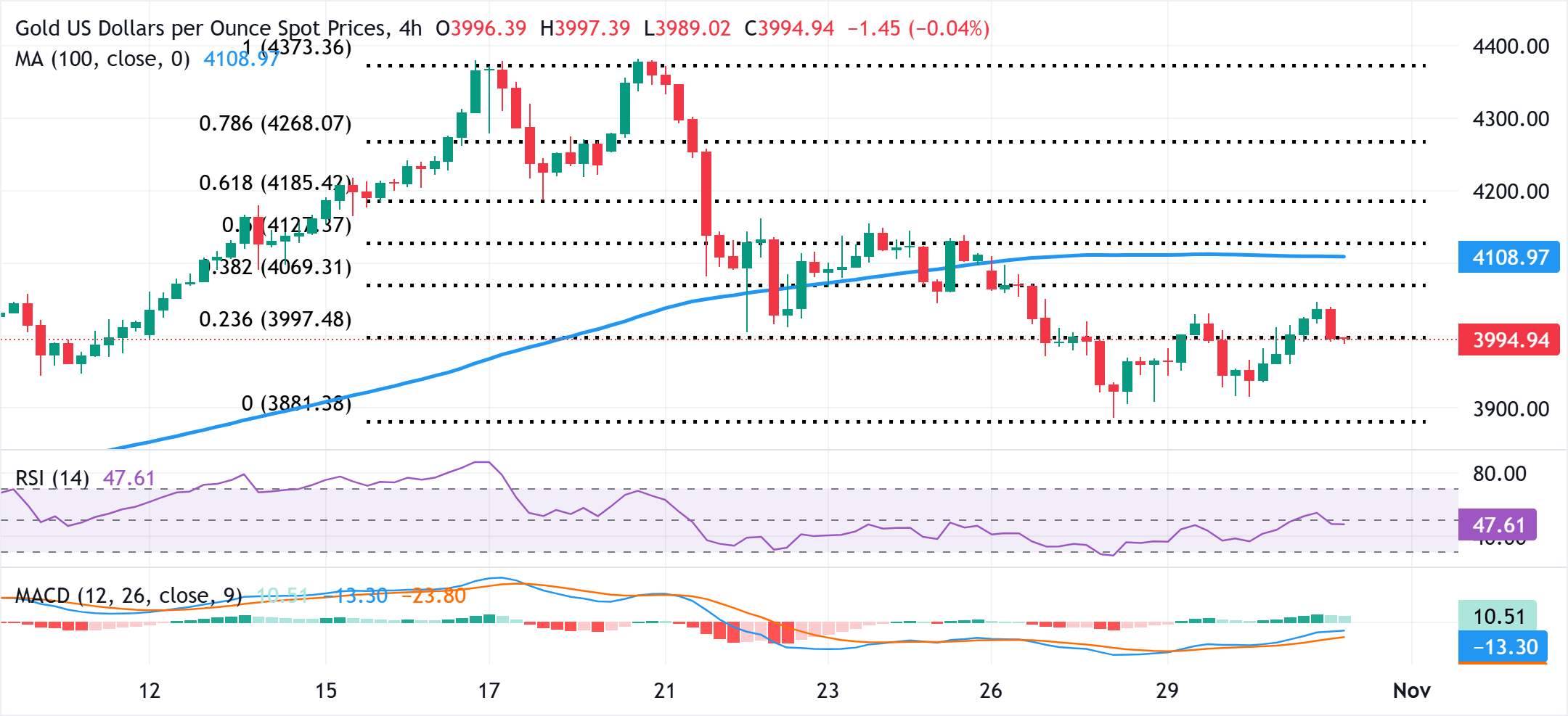
The XAU/USD pair did find acceptance above the 23.6% Fibonacci retracement level of the recent corrective decline from the all-time high, though it lacks follow-through and remains below the $4,050 key hurdle. The said area could act as a key pivotal point, above which a fresh bout of short-covering could lift the Gold price beyond the $4,075 region (38.2% Fibo. level), towards the $4,100 mark.
On the flip side, any further weakness could find some support near the $3,950 area ahead of the $3,917-3,916 region and the $3,900 round figure. Some follow-through selling below the $3,886 zone, or an over three-week low touched on Tuesday, could make the Gold price vulnerable to accelerate the fall towards the $3,850-3,845 zone en route to the $3,800 mark and the next relevant supports near the $3,765-3,760 zone.
US Dollar FAQs
The US Dollar (USD) is the official currency of the United States of America, and the ‘de facto’ currency of a significant number of other countries where it is found in circulation alongside local notes. It is the most heavily traded currency in the world, accounting for over 88% of all global foreign exchange turnover, or an average of $6.6 trillion in transactions per day, according to data from 2022. Following the second world war, the USD took over from the British Pound as the world’s reserve currency. For most of its history, the US Dollar was backed by Gold, until the Bretton Woods Agreement in 1971 when the Gold Standard went away.
The most important single factor impacting on the value of the US Dollar is monetary policy, which is shaped by the Federal Reserve (Fed). The Fed has two mandates: to achieve price stability (control inflation) and foster full employment. Its primary tool to achieve these two goals is by adjusting interest rates. When prices are rising too quickly and inflation is above the Fed’s 2% target, the Fed will raise rates, which helps the USD value. When inflation falls below 2% or the Unemployment Rate is too high, the Fed may lower interest rates, which weighs on the Greenback.
In extreme situations, the Federal Reserve can also print more Dollars and enact quantitative easing (QE). QE is the process by which the Fed substantially increases the flow of credit in a stuck financial system. It is a non-standard policy measure used when credit has dried up because banks will not lend to each other (out of the fear of counterparty default). It is a last resort when simply lowering interest rates is unlikely to achieve the necessary result. It was the Fed’s weapon of choice to combat the credit crunch that occurred during the Great Financial Crisis in 2008. It involves the Fed printing more Dollars and using them to buy US government bonds predominantly from financial institutions. QE usually leads to a weaker US Dollar.
Quantitative tightening (QT) is the reverse process whereby the Federal Reserve stops buying bonds from financial institutions and does not reinvest the principal from the bonds it holds maturing in new purchases. It is usually positive for the US Dollar.

 Copy Link
 Share on Facebook
 Share on X
 Share by Email