Gold builds on momentum beyond $4,000 as softer USD and safe-haven flow boost demand

- Gold attracts some buyers for the second straight day amid a modest USD downtick.
- Economic concerns stemming from the US government closure undermine the USD.
- The Fed’s hawkish tilt could limit USD losses and cap the non-yielding yellow metal.
Gold (XAU/USD) extends its intraday move up beyond the $4,000 psychological mark and climbs to the top end of its weekly range during the first half of the European session on Thursday. The US Dollar (USD) retreats from its highest level since late May amid concerns about the potential economic fallout from a prolonged US government shutdown, and acts as a tailwind for the commodity. Apart from this, persistent geopolitical uncertainties turn out to be another factor driving safe-haven flows towards the bullion.
Any meaningful USD depreciation, however, seems elusive in the wake of the US Federal Reserve's (Fed) hawkish tilt, which might keep a lid on further gains for the non-yielding Gold. Furthermore, the US-China trade optimism might contribute to capping the precious metal. This makes it prudent to wait for strong follow-through buying before confirming that the recent corrective decline from the record high touched in October has run its course, and placing aggressive bullish bets around the XAU/USD pair.
Daily Digest Market Movers: Gold bulls retain intraday control amid reviving safe-haven demand, weaker USD
- The US government shutdown entered its sixth week on Wednesday, becoming the longest in history and surpassing the 35-day record set during President Donald Trump's first term. Economists now seem worried that a prolonged government closure would affect the economic performance.
- The nonpartisan Congressional Budget Office estimated the government shutdown could slice between 1.0 and 2.0% off Gross Domestic Product in the fourth quarter. This caps the recent US Dollar rally to its highest level since late May and supports the safe-haven Gold for the second straight day.
- Russian President Vladimir Putin has ordered preparations for nuclear testing after Trump said last week that the US would be running tests. Moreover, Russia has intensified its offensive and launched coordinated artillery strikes across eastern Ukraine, further benefiting the bullion.
- Automatic Data Processing reported that private sector employment in the US rose by 42K in October, against 25K estimated and a 29K decrease recorded in the previous month. Separately, the Institute for Supply Management's (ISM) Non-Manufacturing Purchasing Managers' Index rose to an eight-month high.
- Traders scaled back their bets for another 25-basis-point rate cut in December following the US Federal Reserve's hawkish tilt last week. This could limit any meaningful USD corrective decline and keep a lid on a further appreciation for the non-yielding yellow metal, warranting some caution for bulls.
- Traders look forward to speeches from influential FOMC members later during the North American session for cues about the future rate-cut path. This will play a key role in driving the USD demand, which, along with the broader risk sentiment, should provide some impetus to the XAU/USD pair.
- On the trade-related front, China said on Wednesday that it would extend a suspension of additional tariffs on US goods for one year, making official an agreement reached in talks between Presidents Xi Jinping and Donald Trump last week.
Gold could accelerate the positive move once $4,025-4,030 hurdle is cleared decisively
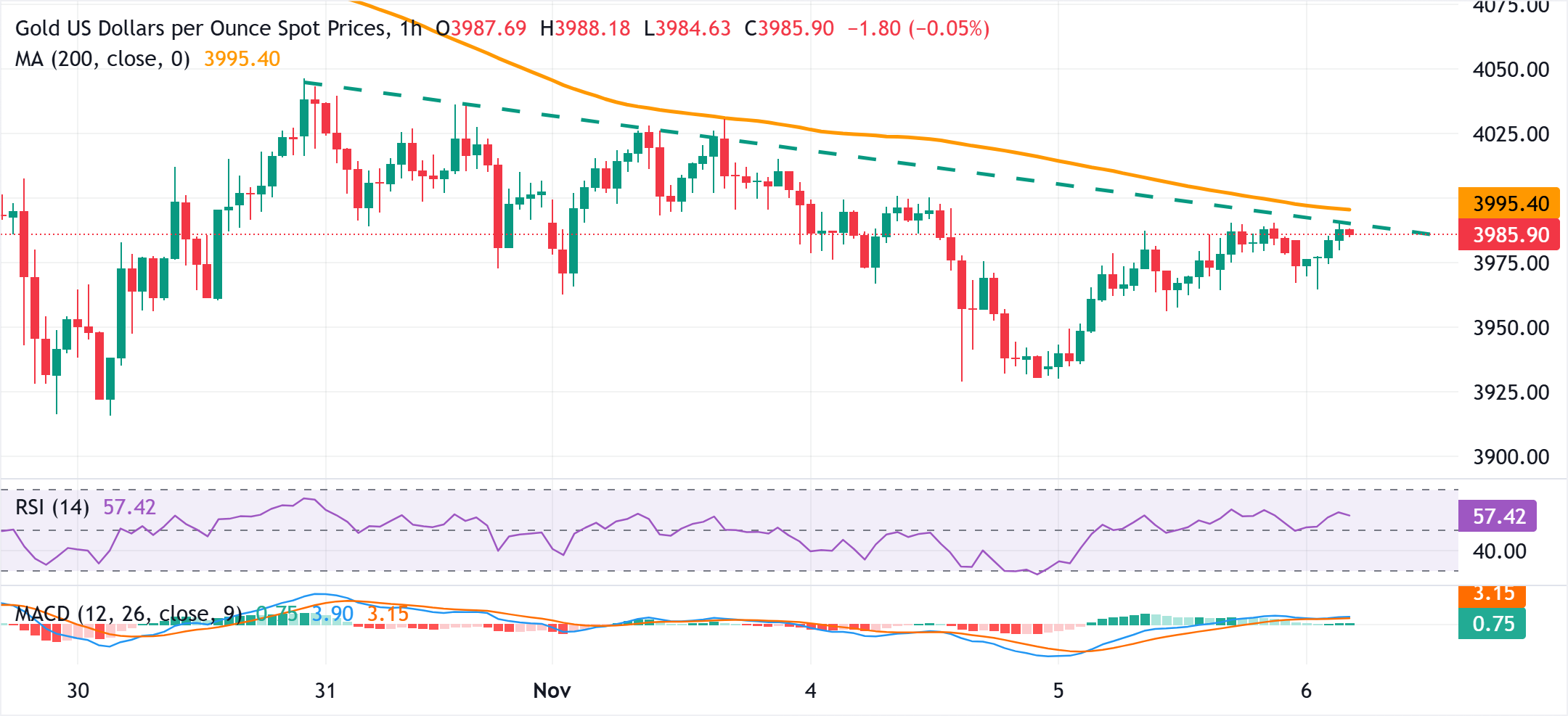
The commodity is currently placed near the $3,990-3,995 confluence hurdle – comprising a short-term descending trend-line extending from last Friday and the 200-hour Simple Moving Average (SMA). A convincing breakout through the said barrier could trigger a short-covering move towards the $4,025-4,030 horizontal resistance. Some follow-through buying beyond the $4,040-4,045 region might shift the near-term bias back in favour of the XAU/USD bulls and pave the way for a move towards reclaiming the $4,100 mark with some intermediate hurdle near the $4,075 area.
On the flip side, weakness below the $3,972-3,970 immediate support might continue to attract some dip-buyers, which should help limit the downside for the Gold near the $3,940-3,935 region. The next relevant support is pegged near the $3,910-3,900 region and last week's swing low, around the $3,886 zone. Failure to defend the said support levels would be seen as a fresh trigger for bearish traders and set the stage for the resumption of the recent corrective decline from the all-time peak.
Fed FAQs
Monetary policy in the US is shaped by the Federal Reserve (Fed). The Fed has two mandates: to achieve price stability and foster full employment. Its primary tool to achieve these goals is by adjusting interest rates. When prices are rising too quickly and inflation is above the Fed’s 2% target, it raises interest rates, increasing borrowing costs throughout the economy. This results in a stronger US Dollar (USD) as it makes the US a more attractive place for international investors to park their money. When inflation falls below 2% or the Unemployment Rate is too high, the Fed may lower interest rates to encourage borrowing, which weighs on the Greenback.
The Federal Reserve (Fed) holds eight policy meetings a year, where the Federal Open Market Committee (FOMC) assesses economic conditions and makes monetary policy decisions. The FOMC is attended by twelve Fed officials – the seven members of the Board of Governors, the president of the Federal Reserve Bank of New York, and four of the remaining eleven regional Reserve Bank presidents, who serve one-year terms on a rotating basis.
In extreme situations, the Federal Reserve may resort to a policy named Quantitative Easing (QE). QE is the process by which the Fed substantially increases the flow of credit in a stuck financial system. It is a non-standard policy measure used during crises or when inflation is extremely low. It was the Fed’s weapon of choice during the Great Financial Crisis in 2008. It involves the Fed printing more Dollars and using them to buy high grade bonds from financial institutions. QE usually weakens the US Dollar.
Quantitative tightening (QT) is the reverse process of QE, whereby the Federal Reserve stops buying bonds from financial institutions and does not reinvest the principal from the bonds it holds maturing, to purchase new bonds. It is usually positive for the value of the US Dollar.

 Copy Link
 Share on Facebook
 Share on X
 Share by Email